On this page
How to play Block Puzzle
Fill a row, a column or a 3×3 box on the 9×9 grid and it clears. Free play is 18 sets of three pieces, and the Daily is 20 sets. A game ends early if none of your pieces fits anywhere.
The rules
- Pieces: three at a time, from 35 fixed shapes of 1 to 9 cells. You cannot rotate them.
- Placing: a piece goes on empty cells and must fit fully on the board. Place all three to get the next set.
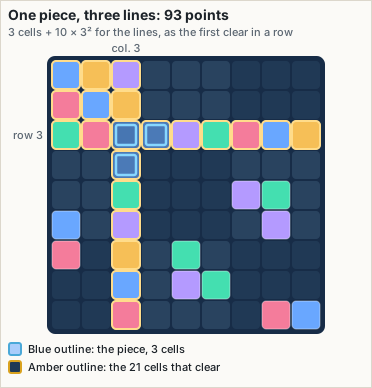
- Clearing: a full row, column or 3×3 box clears at once. The nine boxes are fixed and tinted like a checkerboard. One piece can complete several lines. Cleared cells just become empty, and nothing falls.
Controls
- Drag: press a piece and move it. A shadow shows where it lands, and an amber outline marks cells that would clear. A drop within 0.6 of a cell of a legal spot snaps there. Otherwise the piece goes back to the tray. On a touch screen the piece’s bottom edge stays 32 pixels above your finger.
- Tap: tap a piece, then tap the board. The piece is centered on your tap.
- Keyboard: 1, 2 or 3 selects a piece, arrow keys move it, Enter or Space places it, and Esc lets go.
- Undo: the Undo button or U takes back your last placement. You get 3 per game.
Scoring
| What you do | Points |
|---|---|
| Place a piece | 1 per cell |
| Clear lines (each row, column and box counts as one) | 10 × lines × lines: 10, 40, 90, 160 for 1 to 4 lines |
| Clear again on the next placement | +15 on the second clear in a row, +30 on the third, and so on |
| Clear a marked cell | +20 each |
| Place the last piece of the last set | +200 |
A placement that clears nothing ends the chain. From set 7 the line bonus is also multiplied: ×2 on the second clear in a row, ×3 on the third or later. Only the line bonus is multiplied.
Example, set 7 or later: a 4-cell piece clears 2 lines as your second clear in a row and collects a marked cell. That scores 4 + 40 × 2 + 15 + 20 = 119.
The four phases
| Phase | Sets | What changes |
|---|---|---|
| 1 Place | 1–3 | Place pieces and clear lines. |
| 2 Collect | 4–6 | One piece per set carries a marked cell. |
| 3 Chain | 7–9 | Two marked pieces per set. The multiplier starts, and the chain count restarts at zero. |
| 4 Combine | 10 onward | Nothing new. Big pieces reach their highest weight on Standard and Hard. |
A marked cell shows a small square with a dot. If it clears in the move that places it, you collect it at once. Missing one costs nothing. A Free game has 27 marked cells and the Daily has 31. From set 7 the screen shows “Line bonus ×n · next ×m”.
Easy, Standard and Hard
Pick a level before you start a Free game. Standard is the default, and the game remembers your last choice. Rules and scoring are the same on all three. Only the pieces differ.
| Easy | Standard | Hard | |
|---|---|---|---|
| Shapes in a normal set | 28 shapes of 1–4 cells | All 35 | 32 shapes of 3–9 cells |
| Cells in one set, at most | 12 | 14 | 18 |
| Weight of 5+ cell pieces in phases 2, 3, 4 (phase 1 is ×1) | None dealt | ×1.5, ×2, ×2.5 | ×2, ×3, ×4 |
| Legal spots a set must offer, at least | 6 | 3 | 1 |
Legal spots counts every place any of the three pieces could go on your board. Each set must also be placeable, one piece after another, in some order. If 32 tries give no set that passes, the game deals a set of 1- and 2-cell pieces instead. This rescue works the same on every level, so Hard can deal them too.
Tips and strategy
- Look for the crossing. Lines score 10 × lines², so three lines in one placement give a line bonus of 90. Three one-line clears give 10 each, plus chain points only when they come on back-to-back placements. Look for a cell where a row, a column and a box are all nearly full.
- Plan the whole set. The deal promises that some order works, not that your first choice does. In our 27 October 2026 test, the Planner bot tried every order first and finished 2,000 of 2,000 games on each level.
- Collect the marked cells. Each is worth 20. In the same test, our Greedy bot, which places one piece at a time, collected a median of 22 on each level. That is 440 points, against its Standard median score of 1,152.
- Keep room for big pieces late. On Standard and Hard, the Average and Greedy bot games that ended early stopped at a median of 41 to 44 placements out of 54. Greedy keeps one-cell holes rare and keeps room for a 3×3 square or a 5-cell line.
- Build the chain in phase 3. From set 7, the second clear in a row doubles the line bonus and the third triples it. Line up two or three nearly full lines before the first clear. In that test, Greedy reached ×2 in 1,974 of 2,000 Standard games, at a median of placement 26.
Our numbers
In 24,000 test games on 27 October 2026, a bot that planned each set of three finished 2,000 of 2,000 games on Easy, Standard and Hard. The bots are scripted programs that follow the game’s own rules, not visitors. How we test explains how the bots and the deal checks work.
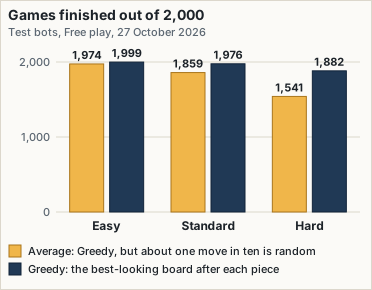
Free play, 27 October 2026. Four bots each played 2,000 Free games on every level. A game is finished when all 54 pieces of the 18 sets are placed. Games finished, out of 2,000:
| Bot | How it plays | Easy | Standard | Hard |
|---|---|---|---|---|
| Random | Any legal placement | 4 | 1 | 1 |
| Average | Greedy, but about one move in ten is random | 1,974 | 1,859 | 1,541 |
| Greedy | One piece at a time, to the best-looking board | 1,999 | 1,976 | 1,882 |
| Planner | Plans each set of three, trying every order | 2,000 | 2,000 | 2,000 |
- Random play does not last. Its games ended after a median of 20 placements on Easy and 17 on Standard and Hard, out of 54.
- Scores: Greedy’s median final score was 1,100 on Easy, 1,152 on Standard and 1,260 on Hard.
Deal check. Those games dealt 363,061 sets. A separate brute-force search tried every order and every place for each one, and none was impossible.
Daily check, 29 October 2026. We replayed the stored solution of every Daily from 2 November 2026 to 1 November 2036, 3,653 dates. That is 219,180 placements, 60 per date, and every one was legal when played in order from an empty board. So each of those Dailies can be finished.
No people played in this test, so we have no human finish rate to give you.
Daily puzzle and records
The Daily is its own mode and always uses Standard’s pieces. Everyone on the same date gets the same 20 sets, which is 60 pieces, with the same marked cells. Each Daily runs from midnight to midnight by your device’s clock.
Your board can differ from the reference game that built the Daily. A set can therefore arrive that fits nowhere on your board. The game says so, and an Undo can free some space.
- One counted game a day: your first finished Daily of the date counts, whether you place all 60 pieces or run out of room. Playing it again that day is practice and changes no records.
- Leaving early: New asks first. A Daily you leave stays saved, because the game saves after every move on this device. A Free game you leave is not recorded.
- Recorded: score, games played, best score and your Daily streak. Easy, Standard, Hard and the Daily each keep their own Best, saved in this browser. The result also lists the phase reached, targets collected, best line bonus and Undos used.
The Daily page explains what the Dailies of our other games have in common.
Frequently asked questions
Can I rotate the pieces?
No. Each of the 35 shapes has one fixed orientation. Sideways and upright versions are separate pieces.
Why did the game end if it checks that my pieces fit?
In Free play, the check runs when a set is dealt. It confirms that the three pieces can be placed one after another, in some order, on your board as it is then. A piece in the wrong spot can block the others later.
How do I get the ×2 and ×3 line bonus?
From set 7, clear a line on two placements in a row for ×2, and on three or more in a row for ×3. A placement that clears nothing resets the chain, and set 7 starts the count at zero even if you cleared with the last piece of set 6.
How many Undos do I get?
Three per game. Place a piece before you undo again. If the game ends with “No room”, you can still use a spare Undo before you see your result. After the last piece of the last set, Undo is off.
Last updated: November 2, 2026.