On this page
How to play Typing Test
Type the text on screen, fast and clean. The clock starts on your first keystroke, so read the first words before you begin.
Controls
| Action | Keys |
|---|---|
| Next word | Space (a Space with nothing typed is ignored) |
| Fix a mistake | Backspace, current word only |
| Clear the current word | Ctrl, Option or Cmd + Backspace |
| Same text again | Esc (Free play) |
| New text after a result | Enter, or tap the result card |
- Locked words: after Space, a word is final. Up to 6 extra letters can show after it. More keys do nothing.
- Not counted: pasted text, held-down letter keys and script input.
- If you click away: click the text or press a key to carry on. A timed test keeps running. Leaving the tab cancels a free test, but the Daily is different.
- After a result: for 1.2 seconds, taps, Enter, Esc and keys you were already holding do nothing, so a stray tap can’t skip your result.
- Other keyboards: non-English characters count as errors, with a note to switch to English.
Text types and lengths
| Type | What you type |
|---|---|
| Words | 1,000 hand-picked lowercase words, 2 to 10 letters, no punctuation. No word comes twice in a row. |
| Sentences | 400 original passages of 45 to 60 words, no digits. Punctuation is at most 6% of characters. Capitals only at sentence starts, in “I”, and in month and weekday names. |
| Numbers | 120 templates with times (7:45), money ($12.50), dates (10/17), ids (#204), percents, counts and years. Characters that aren’t letters or spaces make up 8% to 15% of each sentence. |
- Timed: 15 s, 30 s or 60 s, stopping at exactly that time. A key at or after the deadline isn’t counted.
- By words: 25 or 50 words, stopping on the key that finishes the last word or on the Space after it.
- Defaults: Sentences, 60 s, Keyboard. Settings stay on this device.
How WPM is calculated
A “word” is five characters, a common standard in English text entry that includes spaces and punctuation (Wikipedia, checked 2026-11-01). Only words typed correctly count here.
| Number | Formula | Where the letters come from |
|---|---|---|
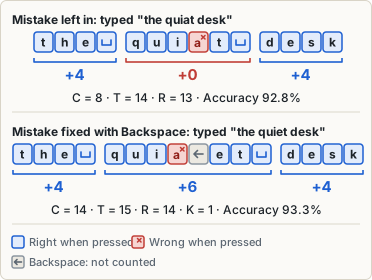
| WPM (headline and Best) | C ÷ 5 ÷ minutes | C = characters in correct words, plus the Space after each. A wrong word counts 0, with its Space. |
| Raw speed | T ÷ 5 ÷ minutes | T = character keys pressed, wrong and deleted ones included. Backspace isn’t counted. |
| Accuracy | R ÷ T | R = keys that were right when pressed. A fixed mistake still counts against you. Rounded down to 0.1%. |
| Classic net | Raw − U ÷ minutes | U = wrong, missing or extra letters left in words. For comparison only. |
Timed tests use the full length as the minutes. Word tests run from your first key to your last. A word still open at time-out counts its correct letters up to the first mistake.
Worked example. In 1.00 minute you get C = 360, T = 375 and R = 367, with 6 mistakes fixed and 2 left:
72 WPM = 360 characters in correct words ÷ 5 ÷ 1.00 minRaw 75 WPM = 375 typed ÷ 5 ÷ 1.00 min97.8% = 367 of 375 keystrokes right · 6 fixed · 2 leftClassic net 73 WPM = raw − 2 errors left ÷ 1.00 min
What the result shows
- While you type: the clock or word count, WPM after the first 2 seconds, Accuracy, and a “×10 clean” counter after 10 words in a row with no wrong key.
- On the card: WPM, Accuracy, the formula with your numbers, and a paragraph picture with one bar per word (filled is right, outlined is left wrong, a dot is a fixed mistake). The details add Raw speed, Classic net, your three most missed keys and the percentile line.
- Share text: its first line ends with ten blocks, one per tenth of the test, such as
72 WPM · 97.8% · ▄▄▅▄▄▄▅▄▃▄(▁ is under 20 WPM, each step adds 20, █ is 140 or more). An Unranked run shows “Unranked” instead of the WPM. Line two gives the test you took.
On a phone
- Start: tap the text to open the keyboard. If you haven’t changed a setting, your first touch on a phone screen switches the game to Phone. Capitals and curly quotes aren’t required.
- Layout: the page scrolls to keep the clock row and your line in view.
- Autocorrect and prediction: accepted, marked Assisted, with their own Best.
Tips and strategy
- Read before you start. The clock runs from your first key.
- Fix a slip before you press Space. A fixed word scores in full and a wrong one scores 0: 14 against 8 in the figure above.
- Don’t chase an old word. After Space it is locked. Ctrl, Option or Cmd + Backspace clears a ruined word at once.
- Look one word ahead. Usually, after the first line, you type on the second row, so the next line is in view.
- Pick the length for your question. A 2-second stop is 13% of a 15 s test and 3% of a 60 s one. In the game’s table script it cost a simulated typist 8.0 WPM at 15 s and 2.0 at 60 s (see Our numbers). Use 30 s, 60 s or 50 words for a figure you can trust.
- Take the middle of three runs. Best keeps your luckiest run, for each type, length and input.
Our numbers
Every figure below comes from our scorer, our content checker or the two studies cited, never from visitors’ results. See How we test.
Content and scoring checks, 29 October 2026
- Text: the 400 passages, 1,000 words and 120 templates passed all 12 content checks with 0 failures. 10,000 generated Numbers texts ran 8.2% to 14.6% characters that aren’t letters or spaces. We wrote all of it ourselves on 21 October 2026, and nothing is copied or paraphrased from books, lyrics, news or other typing sites.
- Human-like timing: 10,000 computer-generated records at 20 to 160 WPM. 0 were flagged Unranked.
- Machine timing: 3,000 generated records with a fixed 120 ms gap and 0, ±0.5 or ±1 ms of jitter, 1,000 of each. All 3,000 were flagged Unranked.
- Rounded clocks: 2,000 records with time rounded to 16.67 or 100 ms. 0 were flagged, and all 2,000 were detected as rounded clocks.
- Second scorer: a separate program rebuilt each score from the raw key record. It matched the game on 1,000 of 1,000 records.
- Limits: these are generated records, not real players, and jitter was tested only up to ±1 ms. A script that varies its timing like a hand is not caught, and we don’t claim it is.
- Phone input: code tests replay iOS-style and Android-style keyboard events, expecting 0 Assisted flags for letter-by-letter and composed typing. They pass in our test suite. We haven’t run them on physical phones yet.
One record, three formulas
The next two tables are the output of the game’s own table script, run on 1 November 2026. It gives the same numbers on every run. It replays simulated typing through the game’s scorer. “Pace” is the speed the generator aims for. Each row is one 60-second run, an illustration and not an average.
| Typing style | Raw | Classic net | WPM here |
|---|---|---|---|
| 40 WPM pace, no mistakes | 40.4 | 40.4 | 40.4 |
| 60 pace, 3% of letters wrong, half fixed | 59.4 | 54.4 | 52.6 |
| 80 pace, 6% wrong, half fixed | 78.2 | 71.2 | 68.8 |
| 100 pace, 3% wrong, all fixed | 99.6 | 99.6 | 97.8 |
| 120 pace, 6% wrong, none fixed | 123.0 | 85.0 | 88.4 |
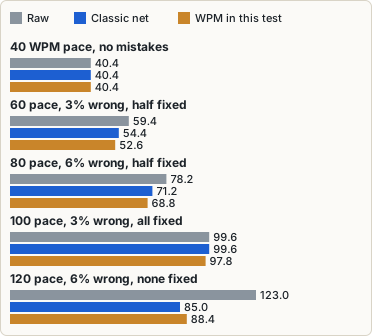
“Fixed” means deleted and retyped at once. At 100 pace Raw and Classic net match, and WPM here is lower because Raw also counts the deleted wrong keys.
One two-second pause
Same script and run date: a simulated 60 WPM typist with no mistakes, scored as typed and with a 2-second stop after the 30th keystroke. One run per cell.
| Length | Without the stop | With the stop | Change |
|---|---|---|---|
| 15 s | 60.8 | 52.8 | −8.0 |
| 30 s | 58.4 | 54.8 | −3.6 |
| 60 s | 59.4 | 57.4 | −2.0 |
| 25 words | 60.6 | 55.6 | −5.0 |
| 50 words | 59.1 | 56.6 | −2.4 |
Where your WPM sits in two published studies
- Keyboard: 168,960 volunteers each typed 15 sentences on a website that offers typing tests and courses. Mean 51.56 WPM, SD 20.2, mean age 24.5, 68% from the US (Dhakal et al., CHI 2018, checked 2026-11-01).
- Phone: 37,370 volunteers, mean 36.17 WPM, SD 13.22, with autocorrect, word prediction and gesture typing allowed (Palin et al., MobileHCI 2019, checked 2026-11-01).
Your percentile compares your WPM with these volunteers. We fit a skewed curve to each study’s published mean, SD and skew, so the percentiles are estimates from the game’s reference curve. Two checks: the keyboard paper puts the fastest 10% above about 78 WPM (Dhakal et al.), and our curve puts 78 WPM at 89.6%. The phone paper reports 75% below 43.98 WPM (Palin et al.), and our curve says 74.8%.
| Your WPM | Faster than, keyboard study | Faster than, phone study |
|---|---|---|
| 20 | 3% | 8% |
| 30 | 13% | 36% |
| 40 | 30% | 65% |
| 50 | 50% | 84% |
| 60 | 69% | 94% |
| 80 | 90% | 99.6% |
| 100 | 98% | over 99.9% |
| 120 | 99.7% | over 99.9% |
Values are rounded down, as on the result card. They don’t rank this site’s visitors: the volunteers chose a typing test and skew young. Both papers (Dhakal et al., Palin et al.) time speed from the first to the last key and report errors apart, so our WPM, which sets wrong words to 0, runs a little lower.
Daily puzzle and records
The Daily is one Sentences passage of 45 to 60 words, typed to the end. Everyone whose device clock shows the same date gets the same passage. The day rolls over at local midnight, and #1 was 1 November 2026. The Daily page explains the parts the games share.
- One counted try: Esc or Start over restarts it until you have typed 10 characters. The 10th uses your try. After that, leaving, hiding the tab or reloading records an Interrupted Daily. It counts as played and keeps your streak, with no score.
- Recorded: WPM, Accuracy and test conditions for your first finished try of the date. Keyboard, phone and Assisted runs keep separate Bests. Replay as practice, offered after a result, leaves your stats alone and gives no percentile.
- Order: the 400 passages come in a fixed order, and none repeats within 400 days. Free play holds back today’s passage and the next 30 days’, and picks passages you haven’t typed first.
- Share picture: it draws word lengths, speeds and right/wrong marks, not the letters.
- On your device: settings, passages typed, one Daily record and your Played, Best and streak numbers. No keystroke log is saved.
Frequently asked questions
How is WPM calculated here?
WPM = characters in correct words, plus the Space after each, ÷ 5 ÷ minutes. A wrong word counts 0. The worked example shows the numbers.
What is a good typing speed?
There is no official line, so it depends on what you need it for. The keyboard study averaged 51.56 WPM and put its fastest 10% above about 78 WPM (Dhakal et al., CHI 2018). On our curve, 30 WPM beats about 13% of those volunteers and 60 WPM about 69%.
Why is my WPM lower here than on another typing test?
Raw speed counts every character key you pressed, and Classic net subtracts errors left in. WPM here counts only finished correct words, so a wrong word scores 0. In the game’s table script (run 1 November 2026), one simulated record scores Raw 123.0, Classic net 85.0 and WPM here 88.4.
What does Unranked mean?
Your keystroke gaps were too regular for a hand: at least 30 gaps, and either their spread is under 3 ms or 80% sit within 2 ms of the middle gap. You still see your WPM and picture, but no score or percentile is saved. If your browser rounds time to 4 ms or more, we skip this check and say so.
What does Assisted mean?
A key press added two or more characters at once, or replaced text, as predictive text, swipe typing and autocorrect do. The run counts, marked Assisted, with its own Best. Keyboard runs marked Assisted get no percentile. Phone runs still do, because the phone study allowed those tools.
Why is there no percentile on my result?
It shows only for Sentences at 30 s, 60 s or 50 words, and for the Daily. It is left out for Words and Numbers, 15 s and 25-word tests, passages you have typed before, practice, Unranked runs and Assisted keyboard runs. The result says which one applies.
Can I take the typing test on my phone?
Yes. Tap the text and type. Capitals aren’t required, Assisted input is allowed, and phone results are kept apart from keyboard results.
Last updated: November 2, 2026.