On this page
How to play Number Trail
The grid runs from 5×5 to 8×8. It holds numbers from 1 up to a highest number, and some boards add walls between cells.
The rules
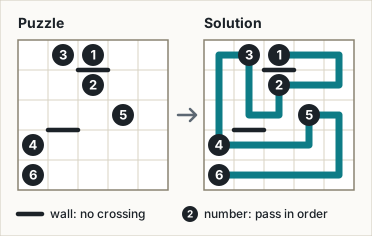
- Draw one line that starts on 1. Move up, down, left or right, with no diagonals.
- Visit every cell exactly once.
- Pass the numbers in order. Any other number refuses the line.
- A wall is a thick bar between two cells. The line cannot cross it.
- The highest number comes last. It refuses the line until every other cell is on it.
The game refuses any move that breaks a rule, so there is no Check button. A line that covers every cell is the solution.
Controls on this screen
- Draw. Press the end of your line, or a cell beside it, and drag. The line stops at the first cell it cannot enter. Press a far cell in the line’s row or column to draw a straight run, when every cell along the way can be entered. On a phone, a drag that starts outside the board scrolls the page.
- Erase. Drag back along the line, or press a cell on it to cut it there.
- Keyboard. Arrows draw one cell, and backward erases one. Shift + arrow runs until blocked. Backspace steps back, U or Ctrl + Z (⌘ + Z on a Mac) undoes, Delete clears and H asks for a hint.
- Buttons. Undo goes back up to 200 moves. Clear returns to 1 and keeps the clock running. Free play adds New and 11 size-and-level buttons, which ask first once your line covers at least a quarter of the cells.
- Clock and saving. The clock starts on your first action, pauses while the tab is hidden and stops at 99:59. Your line, clock and undo history are saved on this device.
Hint, erasing and the result
Hint does not draw the next move. It erases any part of your line that does not match the solution, then dots the next three cells for 2.5 seconds. You draw them yourself. Each press adds one hint, with no limit and no time penalty.
A cell counts as erased when it leaves the line by stepping back (drag, arrow or Backspace), cutting, Clear or Undo. Cells that Hint removes count only as the hint. With no erased cells and no hints, the result is a Clean line. It also shows your time, and a New best when you beat your earlier one.
Tips and strategy
Tip 1 is a rule our grader uses, and tip 2 is a check our tests run on every board.
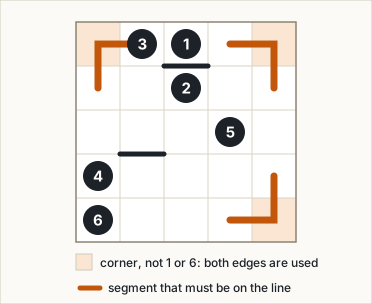
- Fix the corners first. Every cell except 1 and the last number has one link to the cell before it and one to the cell after. A corner has only two neighbors, so a corner that is not 1 or the last number uses both. So does any cell with two open sides, such as an edge cell beside a wall.
- Count the steps between numbers. Color the grid like a checkerboard. Each step changes color, so the steps between two numbers are odd when the rows plus columns between them are odd, and even otherwise. Here 1 and 2 are 1 apart, so the line takes an odd number of steps. The wall rules out a single step, and the solution takes 5.
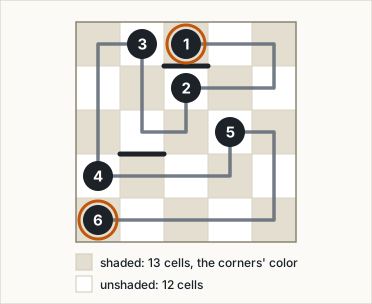
| From → to | Rows + columns apart | Steps along the line |
|---|---|---|
| 1 → 2 | 1 | 5 |
| 2 → 3 | 2 | 4 |
| 3 → 4 | 4 | 4 |
| 4 → 5 | 4 | 4 |
| 5 → 6 | 5 | 7 |
The same idea fixes the ends. A 5×5 or 7×7 board has one more corner-colored cell than the other color, so 1 and the last number both sit on the corners’ color. On 6×6 and 8×8 boards they sit on opposite colors. A board that broke this would have no solution.
- Expect fewer numbers on harder boards. An 8×8 Easy board has a median of 21 numbers, an 8×8 Hard board 10 (see Our numbers). Corners, walls and step counts then do more of the work.
- Read the dim end. If the end of your line has no legal move, it dims after about 0.6 seconds. The game does not warn about a line that can still move but is doomed. Press Hint once to find your wrong turn.
Our numbers
Our own generator made the packs on 21 October 2026, and no puzzle was copied from elsewhere. Our test method is described on How we test. These counts describe boards, not player times.
Median numbers per board (in our test suite)
| Size | Easy | Medium | Hard |
|---|---|---|---|
| 5×5 | 6 | 6 | none |
| 6×6 | 10 | 7 | 6 |
| 7×7 | 15 | 9 | 8 |
| 8×8 | 21 | 11 | 10 |
The Daily (7×7 Medium) has a median of 9. Walls have a median of 1 to 3, depending on the pack. Our grader could not reach Hard on 5×5, so there is no 5×5 Hard pack.
Levels measure reasoning depth, not size. The grader uses four plain rules: two links per cell (one for 1 and the last number), no loops, no early joining of the two ends, and numbers along a stretch that run consecutively in one direction. Easy boards fall to those rules alone. Medium needs one “what if”: assume a link, see the rules break, rule it out. Hard needs a “what if” inside a “what if”.
Checks on 29 October 2026
- One solution each. All 2,850 base puzzles in the 11 packs and all 823 dailies, 3,673 in all, have exactly one solution, matching the stored line. Each graded at its own level (Medium for the Daily). 0 failures.
- Copies and dates. A sample of 890 puzzles, each in all 16 versions (14,240 boards), passed the same checks. 440 dates outside the daily range each gave one solution.
- No repeats. 0 duplicates, counting a turned, mirrored or reversed copy as the same board. 0 boards broke the checkerboard check from tip 2.
Each pack holds 300 base puzzles (150 for 8×8), served in 16 versions: 4 rotations, mirrored or not, numbers reversed or not. A pack deals 4,800 boards (2,400 for 8×8) before it starts again.
Daily puzzle and records
The Daily is one 7×7 Medium board, the same for everyone whose device clock shows the same date. The board changes when your clock passes midnight. The Daily page covers the parts shared by all games.
- Boards. 823 prepared boards cover 1 October 2026 to 31 December 2028, and Daily #1 was 1 November 2026. Dates outside that span cycle through the same 823 in order, each in one of 15 other versions. From 2029 a board can return in disguise: 1 January 2029 shows the 1 October 2026 board.
- Tries. There is no New button. You can Clear and redraw, but the clock keeps running. Finishing is recorded once. A replay is labeled Practice and never counts as a New best.
- Share. The text is your time, such as “0:48 · ”, then ten squares, one per tenth of the line: blue for a hint, green for no erasing, yellow for 1 to 3 erased cells, orange for 4 or more. The Daily image is built only from the cell count, your times, erases and hints, so it cannot spoil the board.
Frequently asked questions
Does every board have exactly one solution?
Yes. On 29 October 2026 our solver found exactly one solution for each of the 3,673 puzzles in the packs. Hint follows that one line.
Do I ever have to guess?
No. Easy needs the four plain rules, Medium one “what if” and Hard two, nested.
Will I see the same board twice in free play?
Possibly, in disguise. Each base puzzle returns in 16 versions, in a fixed shuffled order. Each device starts at its own position in that order, and a reload keeps your board.
Is Number Trail a Hamiltonian path puzzle?
In math terms, yes. Treat each cell as a point. A line that visits every point exactly once is a Hamiltonian path: “a path in an undirected or directed graph that visits each vertex exactly once” (Wikipedia, checked 2026-11-02).
Last updated: November 2, 2026.