On this page
How to play Plumb Stack
A stone hangs from a carriage that slides along a rail at a steady speed. Press, and the thread is cut at that instant, so the stone falls straight down. Your score is the most stones the tower held at once.
Sizes are in game units (u). The plinth you build on is 120 u wide.
Controls
| Mouse | Touch | Keyboard | |
|---|---|---|---|
| Drop the stone | Left button | Tap the play area | Space, Enter or ↓ |
- First stone of a tower: it drops when you let go. Lift within 0.5 s and move under 10 px, so a swipe can still scroll the page. Later stones drop the moment you press, until a reload. Keys drop even the first stone on key down.
- Also: from the first drop until the result card, dragging does not scroll the page. There is no pause button, and leaving the tab stops the clock.
- During a fall, presses do nothing. The next stone hangs 0.31 s after a stand, 0.69 s after a slip and 0.89 s after a topple.
What you see
- Light pillar: where the stone would land at that instant.
- Brass mark: a triangle on the tower. Land on it for a plumb drop. It is hidden when no spot would give one.
- Plumb bob: it hangs from the loose stones’ center of weight. The weakest loose joint flickers amber, the creak, once its margin is under 25% of half its overlap.
The rule
A stone’s weight is width × height × density. Basalt has density 2.2 and the others 1.
Each loose joint, where a stone rests on the one below, is checked. The center of weight of every stone from that joint up, the new one included, must stay inside the overlap of the two stones. Exactly on the edge fails.
- Stand: nothing fails, and the tower grows by one.
- Slip: only the new stone’s own joint fails, or it misses the stone below. The new stone falls.
- Topple: a lower joint fails. That stone, everything above it and the new stone fall. The lowest failing joint decides.
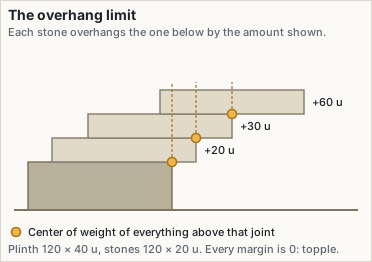
Plumb drop: after a stone stands, if the loose stones’ center of weight is within the tolerance (tol) of the top set stone’s center, the whole tower sets for good. The tolerance is ±10 u at the first stone, falls 0.5 u per stone and stays ±4 u from the 13th.
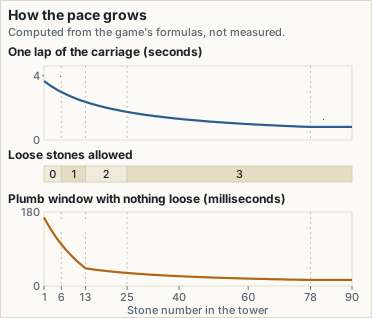
Loose stones: without a plumb drop, only the newest stones stay loose and older ones set. The limit is 0 while the tower is up to 5 stones high, 1 from 6, 2 from 13 and 3 from 25. So a topple first becomes possible when the 7th stone lands, and at most 4 stones fall, the new one included.
Drops: each slip or topple spends one of your three drops, and the last one finishes the tower.
The four stones
| Stone | Width × height before the floor below (u) | From stone | Share once all four appear |
|---|---|---|---|
| Slab | 103–131 × 22–28 (64–84 wide by stone 60) | 1 | 50% |
| Plank | 150–170 × 12 | 8 | 17% |
| Block | 50–58 × 32–36 | 16 | 17% |
| Basalt | 50–56 × 24–26 | 26 | 17% |
“From stone” counts every stone dealt, fallen ones too. The first three stones are slabs. Every stone is also at least as wide as the carriage travels in 0.13 s at the fastest speed the next stone can have (the width floor). So blocks and basalt widen from stone 49, and every stone is 71 u or wider from stone 77.
Tips and strategy
- Follow the pillar, not the stone. Press when it covers the brass mark.
- Go for plumb early. With nothing loose, the plumb window is 2 × tol wide: 167 ms at the first stone and 15 ms at top speed.
- Trust the mark’s offset. It accounts for the loose stones. If they lean left, it sits to the right.
- Respect basalt. It is small but weighs at least 2,640, more than any plank or block. Drop it near the middle.
- A topple slows the carriage. Speed follows the tower’s height: the 41st stone in the tower comes at 340 u/s, the 31st at 285.
Our numbers
These come from our test suite and the game’s code, not from visitors. Runs are from 29 October 2026 unless noted; our How we test page sets out the method.
How the pace grows
Computed from the game’s formulas, not measured. One lap is the carriage going from one end to the other and back.
| Stone in tower | Speed (u/s) | One lap (s) |
|---|---|---|
| 1st | 120 | 3.67 |
| 13th | 186 | 2.37 |
| 78th and up | 540 (top) | 0.82 |
Bot towers
Each bot played 300 Free towers. Loose and Steady aim at the middle of the stone below but sometimes press at a random moment. Reader and Sharp test presses against the rule first. Modeled time is the wait before each press plus 0.31 s per stone and 0.5 s per failed drop.
| Bot | Timing noise (std. dev.) | Random presses: first two stones and new types / others | Median best height | 10th percentile | Median modeled time |
|---|---|---|---|---|---|
| Loose | 100 ms, 60 ms late | 15% / 3% | 29 | 20 | 57.1 s |
| Steady | 60 ms | 3% / 0.6% | 42 | 30 | 60.9 s |
| Reader | 45 ms | 0 | 52 | 39 | 65.5 s |
| Sharp | 25 ms | 0 | 149 | 77 | 141.2 s |
Loose toppled within its first 10 stones in 8 of 300 towers. Sharp hit our 400-stone cap in 3.
Fairness checks
- Widths: 0 of 4,160,000 stones broke the width floor above. That is 10,000 Free courses and 400 Daily dates from 1 November 2026, 400 stones each.
- Careful bot, three replays per course, aiming at the middle of the widest standing zone with ±60 ms error: stones 1–20 failed 2 of 600,007 Free drops and 0 of 24,000 Daily drops. Stones 21–40 failed 586 of 601,151 (0.10%) Free and 16 of 24,049 (0.07%) Daily.
- Dead ends: in those replays, 0 of 3,051,658 Free and 123,761 Daily positions left only presses that slip.
- Display: the pillar’s position equaled the drop position in 10,000 of 10,000 simulated presses and 40 of 40 real clicks made with the game clock paused.
- Same stones everywhere: 400 Daily dates matched in Node, Chromium and WebKit.
- Falling stones (2 November): in 656 test conditions and 181 falls from bot play, each at two frame steps (16 ms and 1/60 s), no stone moved more than 11.98 u sideways in one frame (limit 12 u). Every stone left toward the side the tower tipped (0 the other way), and each dropped at least 21 u within 12 frames, about 0.2 s. Drawing only; scores, the Daily and which stones fall did not change.
Not passed or not measured
- Speed: frame-rate and press-to-screen delay checks need an idle machine. On 29 October ours ran at 67–93% CPU, so they are “not judged”, not passed. A 22 October run at 1,280 px dropped 2.7% of frames against a 2% limit, which we count as a failure. The long-task check (no task over 50 ms) failed at 135 ms and 87 ms in our first 29 October run. On 2 November we made the fall code lighter (every frame it computes is unchanged) and changed the check to replay the heaviest recorded fall through the real frame loop, CPU slowed 4×. Of 5 judged runs, 4 passed and 1 had a 52 ms task; 3 more were not judged because the machine was busy.
- People and devices: touch was tested only in automated browsers, 320 and 390 px wide. No human playtest, real-phone test or Firefox run is in these numbers.
The Daily and your records
- Fixed by the date: the stones. Each stone’s type, size and start side come from the date on your device, so everyone on that date builds the same tower. A new Daily begins at midnight, your time.
- Three tries, each from the first stone. A try is used when you drop its first stone. The tower saves after every drop, and a reload continues it.
- Recorded after the third try: your highest tower, with its plumb drops, longest plumb run and time. On a tie the earlier try counts. Until then nothing is recorded, but tries you leave stay saved on this device; come back the same day to finish them.
- Afterwards, a tap on the card starts an unrecorded practice tower on the same stones.
- Records: Played and Best (in stones), kept apart for Daily and Free play, plus your Daily Streak and Longest.
For streaks and the other parts all our games share, see the Daily page.
Frequently asked questions
Why did my tower fall when the stone landed in the middle?
Older loose joints are checked too, not only the new stone’s. A heavy basalt, or loose stones leaning one way, can carry the weight past a lower edge.
Do I need plumb drops to score?
No. Plumb drops add no points, but each one sets the whole tower for good, which helps from the 6th stone, when stones first stay loose.
Why won’t my tap start the next tower?
Presses in the first 0.7 s after the result card appears are ignored, and longer while the card still shows where your last stone could have stood. A press still held from before does not count either, so lift and press again.
Last updated: November 2, 2026.