On this page
How to play Brick Breaker
The ball bounces off the walls, the ceiling, the bricks and your paddle. Break every brick on a level to move on.
Controls
- Mouse: move the pointer over the board.
- Touch: drag on the board. The paddle moves as far as your finger does.
- Keyboard: Left and Right arrows, or A and D. Click the board or press Tab first.
- Launch: the Launch button, Space or Enter. Nothing moves, and the clock waits, until you launch.
- Pause: the Pause button, P or Esc.
The paddle moves at most 1,080 units a second. On Normal its middle travels 280 units from wall to wall, so that takes about a quarter of a second.
The run
- Levels: three, with 4, 5 and 6 rows of up to 8 bricks.
- Lives: three for the whole run. You lose one only when your last ball falls. Clearing a level gives none back.
- Serves: the next ball launches by itself, 1 second after a lost life and 0.7 seconds after a level.
- Clock: 5:00 on Easy, 3:00 on Normal, Hard and the Daily. It counts down from launch, and pausing stops it. The serve waits count.
Bricks and capsules
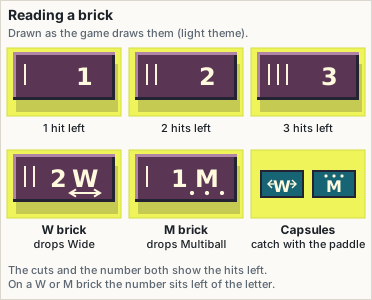
Level 1 bricks break in one hit. In level 2, a quarter of the bricks need two. In level 3, 35% need two and 10% need three. Each count is rounded down.
Each level has two capsule bricks. A W brick drops Wide and an M brick drops Multiball. The capsule falls at 120 units a second. Catch it with the paddle. A missed one costs nothing.
- Wide: the paddle is 1.35 times wider for 10 seconds. Another W resets the timer. Losing a life or clearing a level ends it.
- Multiball: adds balls 18° either side of your oldest ball, up to three in all. At three, nothing happens.
Scoring
- Each brick: 100,000, however many hits it took.
- Full clear: plus 120 for each second left on the clock.
- Nothing else scores. Combos (bricks one ball breaks between paddle touches), capsules and spare lives add 0.
For example, clearing 96 bricks with 60 seconds left scores 9,607,200. The time bonus stays under 21,600 (36,000 on Easy), so one extra brick beats it.
Aiming
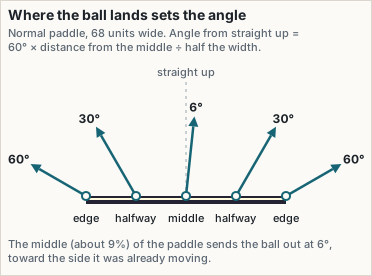
The ball’s angle from straight up is 60° × distance from the paddle’s middle ÷ half its width. Near the middle (about 9% of the width) the angle is nudged to 6°. The paddle catches only from above. A short line near the paddle shows the rebound if you stay put.
Easy, Normal and Hard
| Easy | Normal | Hard | |
|---|---|---|---|
| Paddle width (units) | 88 | 68 | 52 |
| Width with Wide | 118.8 | 91.8 | 70.2 |
| Ball speed at the start (units a second) | 240 | 300 | 360 |
| Top ball speed | 360 | 420 | 480 |
| Clock | 5:00 | 3:00 | 3:00 |
Levels and lives are the same on all three. Each level adds 24 units a second to the ball speed. Every 8 paddle touches in a level add 6 more, up to +72.
Tips and strategy
- Read the board first. Before your first launch the clock waits, and the marks and hit counts are visible. The W brick sits in a level’s bottom two rows. M can be anywhere.
- Steer with halfway hits. Halfway out sends the ball at 30°.
- Aim at what is left. Our best bot lands the ball at the paddle’s middle or 60% of the way to either edge (a 36° rebound), whichever aims at the most bricks.
- With Multiball, follow the ball that lands first. Skip a capsule rather than risk your last ball.
- More balls, faster ball. Every ball’s paddle touch counts toward the speed-up, so three balls reach top speed sooner.
Our numbers
Scripted bots, not people, produced these figures. For the method, see How we test. The skill test used a fresh range of 2,000 seeds, fixed beforehand, and ran on 2 November 2026. It was our fifth range, drawn after Easy’s clock change. The collision, level and aim-line checks below ran that day.
Three bots played those seeds on each difficulty, 18,000 games. A game ends at a full clear, a third lost life or the clock. All three obey the same paddle speed limit as you.
- Random: heads for a new random spot every 0.1 seconds.
- Chase: goes under the lowest falling ball, 0.05 seconds late, off by about 8 units.
- Predict: works out where the first ball lands, bounces included, 0.017 seconds late, off by about 2 units.
| Normal | Bricks cleared (10th, 50th, 90th percentile) | Median game time |
|---|---|---|
| Random | 3, 4, 9 | 10.7 s |
| Chase | 48, 72, 86 | 163.2 s |
| Predict | 72, 82, 93 | 156.8 s |
- Full clears by Predict, out of 2,000: Easy 1,994, Normal 1,665, Hard 1,975. Every game Predict did not clear ended on the clock: Easy 6, Normal 335, Hard 25. On our fourth range, with a 3:00 clock, Predict cleared only 824 Easy games, and the other 1,176 ran out of time, so Easy now has 5:00.
- Difficulty: Chase’s miss rate rose from Easy to Normal and from Normal to Hard. It is balls missed out of balls returning, averaged over games. A one-sided 95% lower bound on each rise was 0.04 (Normal over Easy) and 0.19 (Hard over Normal), rounded down. All six pre-set checks passed, including a new one: Predict must fully clear Easy at least as often as Normal.
- Collisions: we checked 100,000 random ball paths against a separate reference: 209 contacts, none missed by the game, largest timing difference 0.
- Levels: 10,730 seeds made 32,190 levels with no anomalies. With the paddle left still at Easy’s ball speed, the slowest first break on level 1 came 202 ticks (about 1.7 seconds) after launch. We replayed one recorded Predict full clear for each of the 12 first-level shapes on each difficulty. All 36 replays reproduced the recording.
- Same result in three engines: Node, Chromium and WebKit each replayed 100 fixed top-speed sequences and 500 timed-input replays. There were no mismatches.
- Aim line: it matched the real rebound in 10,000 of 10,000 test cases.
Not tested yet: people, real phones and Firefox. Our speed check (desktop browser, 4× slower CPU, phone-sized screen) was not judged, because the computer was busy.
The Daily run and your records
- Fixed by the date: which three of the 12 shapes, how each is mirrored and slid sideways, which bricks take extra hits or hold capsules, and the serve angles.
- Settings: Normal, three lives, 3:00.
- Reset: midnight by your device’s clock.
- One counted run: your first finished Daily of the date, whether you clear it, lose all lives or run out of time. Replays are marked Practice and change no record.
- Leaving: the run saves on this device and waits, paused, when you return.
- Records: Free play keeps Played and Best score for each difficulty. The Daily keeps Played, Best, streak and longest streak. Any finished Daily counts toward the streak.
- Result line:
72 bricks · ×12 · DDDDDD------gives bricks and best combo. Then comes one letter per twelfth of the round (25 seconds on Easy, 15 on Normal, Hard and the Daily): a dash for none, A for 1–2 bricks, B 3–5, C 6–9, D 10 or more. On Easy the cut-offs scale to 1–4, 5–9, 10–16 and 17 or more, so its line reads like a Normal one (same bricks per second).
See the Daily page for what all our Dailies share.
Frequently asked questions
Do I lose a life when one of three balls falls?
No. Only the last ball costs a life. If all three fall together, that is one life.
What happens when Wide runs out?
The paddle returns to its normal width around its middle.
Does pausing use up the clock?
No. The board is hidden while paused, so you cannot plan. The game also pauses when you switch tabs or open Settings.
What does “Performance paused” mean?
The game fell more than 8 physics ticks behind, or one frame took over 250 ms. It stops instead of skipping ahead, and the missed time is not added to your clock. Press Resume.
Last updated: November 2, 2026.