On this page
- The rules, the controls on this screen and the four ways to play
- Tips on corners, risky squares, move counts and the last moves
- Our numbers: five levels measured over 5,400 computer games, plus checks on the rules
- How the daily endgame set works and what your records keep
- Answers to common questions
How to play Disc Flip
Disc Flip is an 8×8 game for two sides, Dark and Light. You place a disc to trap a line of your opponent’s discs, and the trapped discs turn to your color. When neither side can move, the side with more discs wins.
The rules
- Start. Four discs sit in the center: Light on d4 and e5, Dark on e4 and d5. Dark moves first.
- Place a disc. Put one disc on an empty square so that it traps at least one line of opponent discs between itself and another disc of yours.
- Lines. A line runs from the new disc across, up and down, or diagonally. All eight directions count.
- Flip. Every trapped line turns to your color at once, so one move can flip along several lines. Flipped discs do not flip anything else.
- Pass. With no legal move you pass. With one, you must play it.
- End. The game ends when neither side can move, which can happen before the board is full. More discs wins, equal counts draw, and empty squares count for nobody.
Columns a to h run left to right and rows 1 to 8 run top to bottom, so a1 is the top-left corner. The board on screen shows no coordinates, but screen readers announce moves with them, for example “You played d3, flipped 1.”
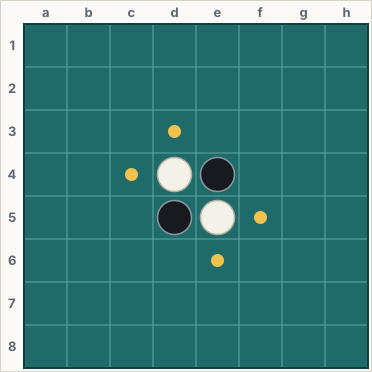
All four first moves flip one disc and are mirror images of each other. A half turn of the board, or a mirror across the a1–h8 diagonal, leaves the start unchanged and swaps them, so no first move is better than another.
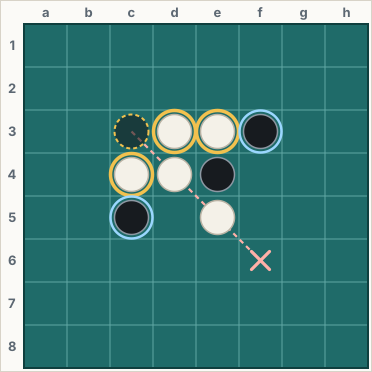
Only an unbroken line flips: it starts next to the new disc, holds only opponent discs, and ends at one of yours. An empty square or the edge of the board ends the line with no flip.
Controls on this screen
The board takes a mouse, touch or the keyboard.
- Preview: with a mouse, point at a square you can play. The discs that would flip get an outline.
- Place: press the square, then release. While you hold, a faint disc and the flip outlines show the move.
- Cancel: slide more than about 10 pixels before you release, or touch with a second finger. The square you first pressed is the one that counts, so dragging to another square does not move your disc.
- Wrong square: a square you cannot play dims when pressed. On release the game says “You can’t place there.” and nothing else happens.
| Action | Keys |
|---|---|
| Focus the board | Tab |
| Move the cursor (it stops at the edges) | Arrow keys |
| Place a disc on the cursor square | Enter or Space |
| Undo (Computer and Two players) | U |
| Hint (Computer only) | H |
| Pass (only when you have no legal move) | P |
| Open Settings (not in the Daily) | S |
| Close a panel | Esc |
The first arrow press puts the cursor on your first legal square, reading left to right and top to bottom.
What the board shows:
- Dots: a dot marks every square you can play (Move dots in Settings, on by default).
- Last disc: a small dot marks the disc played last.
- Rings: a ring marks a settled disc, one that can no longer flip. Corners are always settled, and so are some edge discs next to a held corner. This is Settled-disc rings in Settings, on by default.
- Passes: when you cannot move, a Pass button appears and the game waits for you. When the computer cannot move, it passes on its own and says so for 2.5 seconds.
Four ways to play
- Computer: pick Level 1 to 5 with the numbered buttons above the board. You play Dark and move first unless you choose Light in Settings. Undo and Hint are available. Win three games in a row at a level and the result offers the next level up, with or without help.
- Two players: two people take turns on one device, Dark first. Undo takes back one move at a time. There is no Hint.
- Endgame: a free set of boards from late in a game, with 8, 10 or 12 empty squares. You play Dark and move first, and the computer replies perfectly. Each board is played once, with no Undo and no Hint.
- Daily: three Endgame boards, the same for everyone on a given date (see below).
The button above the board, for example “vs Computer · Level 2 · Dark”, opens Settings. Nothing changes until you press Start. A game in progress, including a half-played Daily board, saves on this device and resumes after a reload.
Tips and strategy
These tips come from the rules and from what our own computer players weigh. We have no data from human players.
Take the corners
A corner disc cannot be flipped. A flip needs an opponent disc on each side of yours in a straight line, and a corner has no square beyond it in any direction. For the same reason, a disc on an edge can only be flipped along that edge. Once you hold a corner, the edge discs next to it can become permanent too.
Be careful beside an empty corner
The squares touching a corner are the risky ones: the four diagonal squares (b2, g2, b7, g7) and the eight edge squares beside the corners (a2, b1, g1, h2, a7, b8, g8, h7). Put a disc on b2 and your opponent can take a1 as soon as a line from a1 runs through your discs to one of theirs. Our computer levels from 2 up score these squares as bad while the corner is empty (Figure 3 below).
Count moves, not discs
Grabbing the most discs is a weak plan. Our flip-grabber bot always plays the biggest flip, yet it beat a random bot only 464 games to 310, and Level 2 beat it 701 to 80 (table below).
Levels 3 and up count how many moves each side would have. Before you place a disc, picture the board after the flips and count the squares your opponent could then play. Discs that touch an empty square give your opponent places to play, so flip discs inside your group rather than on its rim.
Count the empty squares near the end
With no passes, each move fills one square. If an odd number of squares is empty and it is your move, you will fill the last one, and nobody can answer it. A pass changes who plays last, so recount after one.
Use Undo and Hint to learn
- Undo: against the computer, it takes back your move and its reply, with no limit, so you can compare two candidate moves.
- Hint: it shows the move a four-move search would pick, the same search as Level 4. It is a suggestion, not a perfect move.
Train the endgame
Every Endgame and Daily board is picked to meet these rules:
- you can win with best play;
- you have at least three legal first moves;
- exactly one first move reaches par, the best margin;
- at least one first move cannot win;
- the move that flips the most discs does not reach par, and neither does Level 2’s move (without its random wobble).
So do not take the biggest flip by reflex. List your moves, and for each one ask what the computer’s best reply does to the count.
Our numbers
Our method is on the How we test page.
Five levels, measured against each other
We compare each level with its neighbor and with three simple bots. The random bot plays any legal move. The flip-grabber always plays the biggest flip and breaks ties at random. The corner bot looks one move ahead and uses only the square values in Figure 3.
| Matchup (results of the first-named side) | Games | Wins–draws–losses |
|---|---|---|
| Level 1 vs random bot | 800 | 415–31–354 |
| Level 1 vs flip-grabber | 800 | 351–29–420 |
| Random bot vs flip-grabber | 800 | 310–26–464 |
| Level 2 vs flip-grabber | 800 | 701–19–80 |
| Level 2 vs Level 1 | 800 | 707–12–81 |
| Level 3 vs flip-grabber | 200 | 193–1–6 |
| Level 3 vs Level 2 | 200 | 162–3–35 |
| Level 4 vs corner bot | 200 | 193–1–6 |
| Level 4 vs flip-grabber | 200 | 200–0–0 |
| Level 4 vs Level 3 | 200 | 177–2–21 |
| Level 5 vs flip-grabber | 200 | 200–0–0 |
| Level 5 vs Level 4 | 200 | 200–0–0 |
We ran all 12 matchups (5,400 games) on 23 October 2026 and again on 25 October 2026 with identical results. A third run on 29 October 2026 passed again. Colors alternate every game.
The runs have no clock, and Levels 4 and 5 vary little from game to game. Read 200–0 as “clearly stronger”, not as a win rate over all possible games.
What each level does
| Level | How it picks a move | Settings line “Beats a flip-grabber” |
|---|---|---|
| 1 Beginner | A random legal move 80% of the time, otherwise the biggest flip. | 43% |
| 2 Casual | Looks one move ahead. Scores squares (Figure 3) plus 0.15 points per extra legal move, with a random wobble of up to 2 points. | 87% |
| 3 Club | Looks two moves ahead. Scores squares plus 5 points per extra legal move. Picks at random among moves within 3 points of the best. | 96% |
| 4 Strong | Looks four moves ahead with the same scoring. Breaks exact ties at random. | 100% |
| 5 Expert | Searches deeper, up to 70,000 positions or 2.5 seconds. Adds 15 points per extra settled disc once a corner is taken and takes off 3 per extra disc touching an empty square. With 20 or fewer empty squares it gives the side to move 8 points if the count is odd and takes off 8 if it is even. Reads the last 10 empty squares to the end. | 100% |
The last column is the line the Settings panel shows: wins only, draws left out, rounded down, from the ladder above.
How the computer values squares
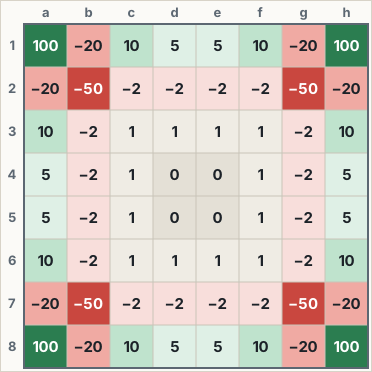
The last ten squares at Level 5
At 10 or fewer empty squares, Level 5 picks the move with the best final disc margin. On 23 October 2026 we gave it 200 test positions with exactly 10 empty squares. It finished all 200 inside its 70,000-position and 2.5-second limits, and the slowest took 8.6 milliseconds in a browser worker on our test machine. If a search ever ran out of room, the game would fall back to a shallower one.
Checks on the rules
- Move counts: from the starting position our engine counts 4, 12, 56, 244, 1,396, 8,200 and 55,092 sequences of 1 to 7 moves. A deliberately simple counter agrees for 1 to 6 moves.
- Previews: the outline matched the discs that really flip in all 10,000 random positions tested.
- Settled discs: in 10,000 random games, no ringed disc flipped later.
These ran in our test suite on 29 October 2026.
The Daily and Endgame boards
- Sets: 1,260 Daily boards (three a day for 420 days) and 900 Endgame boards (300 each at 8, 10 and 12 empty squares).
- Second solver: a separate checker, with its own search but the game’s move rules, rechecked every board in both sets on 25 and 29 October 2026 and found 0 failures. After every first move on every board, the game’s own solver gave the same values and the same reply.
- No repeats: no board appears twice in its set, even rotated or flipped.
- Filtering: on 23 October 2026, of 50 candidate positions with 12 empty squares, 10 (20%) passed every board rule.
- Computer replies: the heaviest reply on the boards we built needs 67,620 positions, which is 23% of the 300,000-position limit (23 October 2026).
Daily puzzle and records
The Daily Endgame Trio
The Daily is the same three Endgame boards for everyone on a calendar date. A new trio starts at midnight on your device’s clock. The table holds 420 days (60 weeks) of boards and then starts over, so the weekdays stay in step. What every game’s daily shares is on Daily.
- Sizes: Monday to Wednesday the boards have 6, 8 and 10 empty squares. Thursday to Sunday they have 8, 10 and 12.
- Rules: the same as Endgame mode.
- Par: par is the best margin (Dark minus Light) you can reach against perfect play. A board counts as par if you match it, as won if you win with less, and as not won otherwise.
- The day: you win the day by winning at least two of the three boards. The result reads “Perfect” if all three reach par. Otherwise it reads “N off par”, the total margin you left behind.
- After you finish: Replay as practice lets you play the trio again without changing your records. The Play the computer button in the top row starts a normal game and keeps your Daily progress.
- Sharing: the share line is one colored square per board (par, won or not won) plus “Perfect” or “N off par”. The share picture is built from each board’s empty count, par, your margin, final disc counts, move counts, flips and your total thinking time. It shows no board or moves.
What your records keep
- Per setting: Played, Win % and Best are kept separately for each of Levels 1 to 5, Two players and each Endgame size (8, 10 and 12 empty squares). The Daily has its own record.
- Best: your biggest winning margin. Against the computer it counts only if you won without Undo or Hint, though a win with help still counts as a win. In Endgame it is your margin on a board you won. In the Daily, Best is how many of the three boards reached par on a day you won, kept separately for the Monday–Wednesday and Thursday–Sunday sizes.
- Daily streak: it counts the days you won, with a Longest figure beside it. A day you lose, or skip, starts the count over.
- Resigning: Resign, or press Start in Settings or a level button after you have moved against the computer, and a loss is recorded after a 6-second window in which you can press Undo.
Frequently asked questions
Which level should I start on?
Level 2, which the game opens on. After three wins in a row, the result offers Level 3. If Level 2 is too hard, try Level 1, which plays a random move 80% of the time.
How strong is Level 5?
In our ladder it won 200 of 200 games against Level 4 and 200 of 200 against the flip-grabber (23 and 25 October 2026). These are computer-against-computer results, and we have no results for human players.
What does par mean in the Daily and Endgame?
Par is the best final margin (Dark minus Light) you can reach against a computer that plays perfectly. The result line reads like “You +6 · Par +8”.
Last updated: November 2, 2026.