On this page
- The board, the five rules and the move limit, with a figure from deal #1
- Tap, drag and keyboard controls on this screen
- Tips tied to how our levels and deals behave
- Our numbers: how we set the levels, the 3,300-deal bank and what our tests found
- The daily deal and your records
- Answers to eight common questions, with sources
How to play FreeCell
FreeCell is a solitaire game played with one 52-card deck. You can see the whole layout from the first move, because no card is face down. You win when the 52 cards sit on the four foundations.
The board
- Eight columns. The left four start with 7 cards each and the right four with 6.
- Four free cells. They sit at the top left. Each holds one card. Whatever the level, you play with four cells.
- Four foundations. They sit at the top right, one per suit. Each empty foundation shows its suit.
The five rules
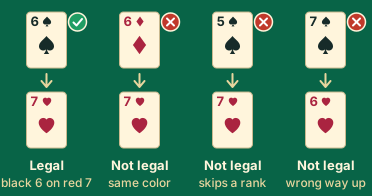
- Build down in alternating colors. A card can go on a card that is one rank higher and the opposite color, such as a black 6 on a red 7. Aces count as 1 and kings as 13. Nothing goes on an ace, and a king can move only to an empty column, a free cell or its foundation.
- A free cell holds one card. Park a card in an empty cell. Take it out later onto a column, an empty column or a foundation.
- Foundations build up by suit and stay put. Start with the ace, then add 2, 3 and so on up to the king. The game does not let you take a card back off a foundation.
- Only the bottom card of a column can move, or a run that ends in it. A run is a stretch of cards that already follows rule 1, such as 7♥ 6♠ 5♦.
- An empty column takes any card or run that fits the move limit. The game refuses to move a whole column into an empty one, because nothing would change.
Moving several cards at once
You can move a run in one go. The limit is how many cards you could move one at a time, using your empty free cells and empty columns as parking:
(empty free cells + 1) × 2 to the power of (empty columns)
When you move into an empty column, that column does not count as parking, so use one fewer empty column. Wikipedia gives the same rule (checked 2026-11-01). The table shows the most cards you can move onto a column that has cards.
| Empty free cells | 0 empty columns | 1 | 2 | 3 |
|---|---|---|---|---|
| 4 | 5 | 10 | 20 | 40 |
| 3 | 4 | 8 | 16 | 32 |
| 2 | 3 | 6 | 12 | 24 |
| 1 | 2 | 4 | 8 | 16 |
| 0 | 1 | 2 | 4 | 8 |
With 2 empty cells and 1 empty column, you can move 6 cards onto another column but 3 into the empty column itself. The number after “Max” above the board shows this limit for a column that has cards. It stops at 13, the length of a run from king down to ace. If you try a run that is too long, the cards shake and a message says why.
Controls on this screen
Mouse and touch
- Tap or click a card to send it to the first place that takes it: a foundation, then a column that has cards, then a free cell, then an empty column. Tap a card in the middle of a run and the whole run below it moves, if the limit allows.
- Drag to choose the place yourself. A drag starts after about 8 pixels of movement, and on a touchscreen the card rides 28 pixels above your finger. Let go within about 40 pixels of a spot that takes the card and it snaps there. Anywhere else, it slides back, and so it does if a second finger touches down.
Buttons under the board
- Undo and Redo: Undo takes back your last move and any cards that Auto sent up with it. Redo brings it back until you make a new move.
- Hint: lights one card and its destination for 2.5 seconds, and names the move in a short message.
- Auto: switches the automatic safe moves on or off. It is on by default.
- ⟲ restarts the same deal. Redo can bring your moves back, and the clock keeps running.
- ⋯ opens New deal, the deal-number box and a “Four-color suits” switch. It turns ♣ green and ♦ blue.
- Finish appears when no lower card is buried under a higher one in any column. One press sends the rest up.
The info row shows the deal number, your moves, the clock and Max. The clock starts at your first move, keeps running through Undo, and stops when you leave the tab. Above it, Free play shows the four level buttons and the daily reads “Daily #N · Medium”.
Keyboard. Click the board or Tab to it first. The top row holds the four free cells, then the four foundations. The bottom row is the eight columns.
| Action | Keys |
|---|---|
| Move the selection across a row (it wraps) | ← → |
| Select more cards of a run. At the full run, go to the top row | ↑ |
| Select fewer cards, or go down from the top row | ↓ |
| Send the selection to the best place | Enter |
| Pick up, then drop where you moved to | Space, then Space |
| Cancel a pick-up. With nothing picked up, restart the deal | Esc |
| Undo | U or Z |
| Redo | Y |
| Hint | H |
The result shows your time, moves, undos and hints, and for deals in our banks how many moves our solver needed.
FreeCell tips and strategy
Read the whole board before the first move
Find the four aces and the four twos and count the cards on top of each. Dig toward the shallowest first.
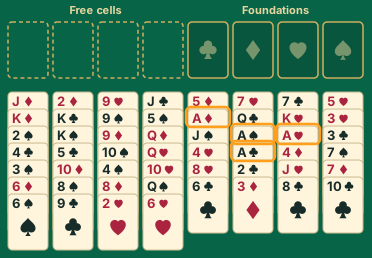
Deal #1, in the figure above, shows how this pays off. Column 6 holds A♠, A♣, 2♣ and 3♦ in a row at the bottom. Put the 3♦ in a free cell and the 2♣ in another. With Auto on, the A♣ and A♠ then go up by themselves, and so does the 2♣ from its cell. That is two moves of yours and three cards on the foundations. We ran this line through the game’s own engine to check it.
Guard your free cells and empty columns
- Each filled cell shrinks your limit. With no empty column, four empty cells let you move 5 cards at once. Four full cells let you move 1.
- An empty column is worth more than a cell. A cell adds one card to the limit. A column doubles it. With 2 empty cells, one empty column lifts your limit from 3 cards to 6.
Know a card’s two homes
Each card from ace to queen has two places it can go in a column: on either of the two opposite-color cards one rank higher. A black 6 fits on the 7♥ or the 7♦. Before you park a card in a cell, find those two cards. If one is exposed or close to the bottom, plan around it. Also look at what is buried before you cover a column: a 6 placed on a 7 that hides a 2 delays that 2 until the whole run moves again.
Learn what Auto does
With Auto on, the game sends a card up when that cannot hurt you. Aces and twos go as soon as they can. A higher card goes only when both opposite-color cards one rank lower are already on their foundations. So the 5♥ goes up by itself only when the 4♥ and both black 4s are already up. Nothing left in play can need it as a landing spot.
Use Undo and Hint to explore, not to skip thinking
Undo has no limit and does not cost you a win or a streak, so try a line and back out if it traps you.
The hint first looks for a safe card that can go up. If there is none, it shows the first move of a winning line that our solver finds from your current position. The search stops after 1.5 seconds. If it finds nothing by then, it says “No move found from this position. Try undoing.”
A hint counts only when it shows a move. Asking again in the same position does not add to the count, unless you reload the page. A win with hints still counts as a win and still extends your streak. It does not count toward your best time or fewest moves.
Match the level to your habits
Our solver won each Easy deal using one free cell, so on Easy a line exists that needs only one cell at a time. If you are filling three, back up. On Hard and Expert the solver needed 3 or 4 cells, so plan when to free them. How we set the levels explains why.
Our numbers: levels, deals and checks
These numbers come from the deals stored in the game and from our test suite. We give the date and the count wherever our records have them. Our method is on how we test.
How we set the level
The level is the fewest free cells our solver needed to win the deal. A solver is a program that plays the game for us. Easy means it won with 1 cell, Medium with 2, Hard with 3 and Expert needed 4. You always play with four cells, whatever the level.
To build the bank we drew deal numbers at random from 1 to 1,000,000. We skipped the 8 known unsolvable ones and any repeats. We examined 24,448 deals. For each try the solver could search up to 200,000 positions. The first 1,664 deals were sorted completely:
| Level | Free cells our solver needed | Deals in the game | Share of the 1,664 sorted deals | Solver’s line with 4 cells: median moves (10th to 90th percentile) |
|---|---|---|---|---|
| Easy | 1 | 1,000 | 13.5% (225) | 64 (49–83) |
| Medium | 2 | 1,000 | 60.9% (1,014) | 68 (54–86) |
| Hard | 3 | 1,000 | 24.0% (399) | 72 (56–91) |
| Expert | 4 | 300 | 1.5% (25) | 76 (60–94) |
| No win found | none within the limit | 0 | 0.06% (1) | – |
The bank sizes and the move counts were counted on 1 November 2026 from the deal lists shipped with the game. The shares come from the bank-building run. Only 1.5% of the sorted deals needed all four cells, which is why Expert holds 300 deals instead of 1,000.
The level is the fewest cells our solver won with, and for some deals that is not proven to be the true minimum. Of the 2,300 deals above Easy, 2,110 had every smaller cell count searched to the end with no win. For the other 190 (8.3%), at least one smaller count stopped at the search limit. We counted these on 1 November 2026 from the solution file shipped with the game. A person or a stronger solver might win those 190 with fewer cells.
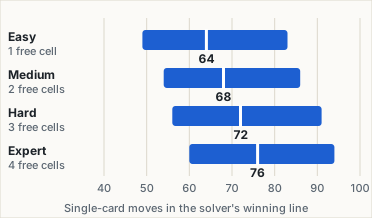
The medians climb by about four moves per level, but the ranges overlap almost completely. Free cells, not move count, define a level. The solver counts single-card moves, so a run you move together is one move for you and several for it. It does not count cards Auto sends up. Its line is not guaranteed to be the shortest, so treat it as a yardstick, not a score to beat.
What our tests found
These checks are part of our test suite. Its last full run, on 27 October 2026, passed 384 tests in 35 files:
- 3,300 of 3,300 saved lines win. Each deal in the bank has a saved line, and the test replays it under the game’s rules with the level’s number of free cells.
- The 8 known unsolvable deals have no win. Our solver searched each one until it ran out of positions and found none. It won each of deals 1 to 100.
- Free play served no stray deals. In 20,000 picks, 5,000 per level, each deal came from its own level’s bank and none was one of the 8. Daily picks for 1,201 consecutive day numbers all came from the Medium bank.
- Auto passed its safety check. We took 1,000 positions reached by random legal moves in banked deals. Each had a safe card for Auto to send up and was winnable. After Auto moved the safe cards, 0 of the 1,000 became unwinnable.
- The move limit matches the formula. We checked 0 to 4 empty free cells and 0 to 3 empty columns, which is 20 combinations, with runs of 1 to 12 cards. The game allowed the runs the formula allows and no longer ones.
The hint answered in time. In a run on 25 October 2026, it answered within 1.5 seconds on 100 of 100 positions taken part-way through saved winning lines. Every move it returned was legal.
A deal you type in that is not in our bank was not checked by us. The game warns you only for the 8 known unsolvable numbers.
Daily deal and records
The daily deal
- Same deal, same date. Everyone whose device shows the same calendar date gets the same deal. The shared rules are on the daily page.
- A Medium deal. It comes from the 1,000-deal Medium bank, in bank order, starting with day #1 on 1 November 2026. No deal repeats for 1,000 days.
- One scored play. Your first finish of the day counts. Later finishes show “Practice” and change nothing.
- Leave and come back. An unfinished daily is saved. New deal from the daily takes you to Free play, with no loss.
- What it records. The record line reads “Daily streak N · longest M”. A win with hints still extends the streak, but only a win without hints can set your best time. A scored daily win also counts in the Medium line of your Free play records.
Free play records
- Per level. Easy, Medium, Hard and Expert each keep played, won, win rate, streak, best time and fewest moves, the last two from wins without hints only. Numbers you type in keep their own record, “Chosen deal”.
- A new deal mid-game is a loss. In Free play, a new deal after your first move, or a tap on a level button, counts as a loss and ends that level’s streak. A confirmation asks first, with “Keep playing” selected. After you confirm, a 6-second Undo bar can still bring the old deal back and record nothing. A new deal before your first move is free.
- Saved on this device only. Records, settings and unfinished deals live in local browser storage, so another browser or device starts empty. The game holds your five most recent unfinished deals.
Frequently asked questions
Can you win any FreeCell deal?
Nearly all of them. Among the original 32,000 numbered deals, only #11982 is unsolvable (Wikipedia, checked 2026-11-01). Wikipedia also reports that Theodore Pringle and Shlomi Fish found 102,075 impossible deals among 8.6 billion in 2018, about 1 in 84,000. Each deal in our levels and the daily has a saved winning line.
Which FreeCell deal numbers are unsolvable?
In deals 1 to 1,000,000, eight are known to be unsolvable: 11982, 146692, 186216, 455889, 495505, 512118, 517776 and 781948 (Goodsol’s FreeCell help, checked 2026-11-01). None of them is in a level bank or the daily. If you type one into the deal-number box, the game asks whether to play it anyway.
How many cards can I move at once?
(Empty free cells + 1) × 2 to the power of the empty columns, with one fewer empty column counted when you move into an empty column. The Max figure above the board shows your current limit.
Why do some cards go up to the foundation by themselves?
That is Auto, on by default. It sends aces and twos up at once, and a higher card only when both opposite-color cards one rank lower are already up. Press Auto to switch it off, then tap a card to send it up yourself.
What do Easy, Medium, Hard and Expert mean?
They are the fewest free cells our solver needed to win: 1, 2, 3 and 4. You always have four. Of the 1,664 deals we sorted completely, 13.5% were Easy, 60.9% Medium, 24.0% Hard and 1.5% Expert.
How do I play a specific deal number or replay a deal?
Open ⋯, type a number from 1 to 1,000,000 in the deal-number box and press Play. The box also accepts forms like #31257 and remembers your last 10 numbers. Press ⟲ to restart the deal you are in, or “Replay this deal” on the result to play a finished one again.
Do Undo, restart, a new deal or hints affect my record?
Undo, Redo and restart do not count as a loss and do not stop the clock. A new deal after your first move in Free play counts as a loss, but not in the daily. A hint that shows a move leaves the win intact but keeps it out of your best time and fewest moves.
Who made the first computer version of FreeCell?
Paul Alfille. Wikipedia says he implemented the first computerized version at the University of Illinois, for the PLATO educational computer system, in 1978 (Wikipedia, checked 2026-11-01).
Sources and checks
Outside our own data, we checked two pages on 2026-11-01. Wikipedia’s FreeCell gives the layout, the move-limit rule, the history and the 2018 search. Goodsol’s FreeCell help gives the eight numbers: “Only the games #11982, #146692, #186216, #455889, #495505, #512118, #517776, and #781948 are known to be unsolvable.”
Everything else is ours: counts and figures from the files shipped with the game, the deal #1 figure and column 6 line from the game’s own dealing and move code, and test results from our test suite (full run 27 October 2026, hint timing 25 October 2026).
Last updated: November 2, 2026.