On this page
How to play Mahjong Solitaire
Remove pairs of matching tiles until the board is empty. You can only pick tiles that are free. There is no score and no time limit. The clock only records how long you took.
The tiles
The full set has 144 tiles. Dots, Bamboo and Characters run from 1 to 9. Add four winds (East, South, West, North) and three dragons (Red, Green, White). Each of those 34 faces comes in four copies. Then add four flowers and four seasons.
Two tiles match when they show the same face. The exception: any flower matches any other flower, and any season matches any other season. A flower does not match a season. Flowers carry a small F in the top-left corner and seasons a small S in the top-right corner.
Which tiles are free
A tile is free when nothing lies on top of it and its left or right side is open. One open side is enough.
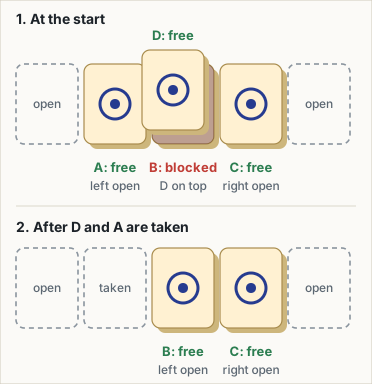
Free tiles are drawn bright and blocked tiles dim. Settings can turn the dimming off. On a narrow screen the board turns on its side when that makes the tiles bigger. Then “left or right” means above or below on your screen.
In Turtle, the tile at the left end sits half a tile off the grid between two rows and blocks the end tile of each. The single tile on top rests on the four tiles of the layer below.
The four layouts
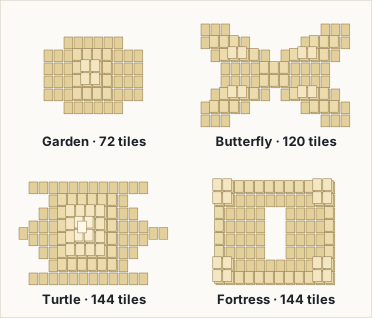
Garden, Butterfly, Turtle and Fortress run from 72 to 144 tiles. In Free play, pick one above the board. The game remembers your choice, and Turtle is the first you see. Daily picks for you by weekday.
Controls
| Action | Touch or mouse | Keyboard |
|---|---|---|
| Pick a tile | Tap or click a free tile. It lifts and gets an outline. Tap it again to let go. | Arrow keys move the cursor. Enter or Space picks. |
| Remove a pair | Tap a second free tile. If it matches, both go. If not, your pick moves to it. | Enter or Space |
| Tap a blocked tile | The tiles blocking it are outlined for half a second. Your pick stays. | – |
| Clear your pick | Tap empty space. | Esc |
| Hint | Hint button | H |
| Undo | Undo button | U or Ctrl + Z (⌘ + Z on a Mac) |
| Shuffle | Shuffle button | S |
| New deal | New button. It asks first once you have made a move. | N |
| Start this deal again | Restart button | – |
- Keys: they work while focus is inside the game. Click the board or press Tab. The first arrow key shows the cursor.
- Near misses: a tap within about 6 pixels of a free tile picks that tile, even if it lands on a blocked one.
- Settings and clock: Show free tiles, Show timer and Show match count. Hiding the timer hides the display only. The clock starts at your first pick, hint or shuffle, stops while the tab is hidden and caps at 99:59.
Hint, Undo, Shuffle and getting stuck
- Hint: unlimited and counted. It outlines a pair for about 1.6 seconds. If the game knows a way to clear the board from here, the pair is the first step of that way. If not, after up to 1.2 seconds it suggests the pair that frees the most new tiles.
- Undo: unlimited and counted. One tap takes back your last pair or your last shuffle.
- Shuffle: three per deal. It re-deals the faces of the tiles left and keeps every tile in place. The new arrangement can be cleared. Undo does not give a shuffle back. If the game cannot build one, nothing changes and you keep the shuffle.
- No matches left: a panel offers Shuffle (if you have any left), a back button, Restart and Keep playing.
The back button reads “Undo N moves”, “Back to last shuffle” or “Back to start”. It returns to the last position the game knows can be cleared: the start, just after a shuffle, or one its solver has confirmed. It counts as N undos. If you press Hint on a board the solver has proved dead, the same panel opens as “This board can’t be cleared from here”.
Tips for clearing the board
- Open the most new tiles. Prefer pairs that uncover tiles: the tops of stacks and the ends of long rows. Our fallback hint uses the same rule.
- Mind the last two of a kind. If they end up one on top of the other, they can never be paired where they stand. A shuffle or an undo gets you out. With only those two tiles left, a shuffle cannot help, because the game cannot re-deal two stacked tiles. So before you take a pair from four copies, check where the other two sit.
- Read the Matches counter. It counts pairs you can take now. Four free copies of one tile make six pairs, so a high count can come from a single kind.
- Undo before you Hint. A clear that used a hint cannot set “Best without hints”. Undo and Shuffle do not disqualify it.
- Use the layout’s shape. Butterfly starts the most open, with 56 of its 120 tiles free. Turtle keeps 57 of its 144 tiles in stacks, so work those early. In Fortress the four corner towers are free from the start, and clearing them opens the long top and bottom walls, which you can take only from the ends.
Our numbers
These come from the game’s own test runs on 25 to 29 October 2026. How we run the checks is on How we test.
| Layout (our label) | Tiles | Layers | Tile kinds | Free at the start | Share free |
|---|---|---|---|---|---|
| Garden (Easy) | 72 | 3 | 18 | 24 | 33% |
| Butterfly (Medium) | 120 | 3 | 30 | 56 | 47% |
| Turtle (Classic) | 144 | 5 | 36 | 35 | 24% |
| Fortress (Hard) | 144 | 3 | 36 | 32 | 22% |
A tile kind is four tiles that match one another, so the full set has 36. Garden and Butterfly leave some kinds out, chosen at random for each deal. Turtle’s layers hold 87, 36, 16, 4 and 1 tiles from the bottom up. We have no player timing data yet, so these labels are not based on solve times.
Fairness checks, run on 25 October 2026:
| Check | Sample | Result |
|---|---|---|
| Deals replayed from their stored solution | 100 per layout (400), plus 200 per layout (800) in unit tests | 0 bad deals |
| Daily dates | 400 dates | 0 failures |
| Solver without the stored solution, Turtle starts | 10,000 deals | 34 undecided (0.34%), 0 unsolvable |
| Same, Fortress starts | 1,000 deals | 8 undecided (0.8%), 0 unsolvable |
| Same, Garden and Butterfly starts | 100 deals each | 0 undecided |
| Shuffles | 400 positions (100 per layout) after up to 60 random pairs | 397 re-dealt and cleared, 3 Garden positions refused, 0 bad |
| Dead ends and Undo N | 100 games played at random until stuck, 9,140 move checks | Undo N replayed 100 times, 0 invalid |
“Undecided” means our solver hit its limit of 200,000 positions before it could prove an answer. Those deals still carry the solution they were built from. In the game, hints search up to 30,000 positions to stay quick. When that is not enough, the Hint falls back to its rule of thumb.
On 29 October 2026 we rebuilt the 60 daily deals for 1 November to 30 December 2026 and replayed each stored solution. All 60 matched the earlier build. In a 26 October 2026 check on a 390-pixel-wide phone screen, all 144 Turtle tiles and the buttons fit, with tiles 43 by 32 pixels.
Daily deal and records
The layout follows the weekday of your calendar date: Garden on Monday and Thursday, Butterfly on Tuesday and Friday, Turtle on Wednesday and Saturday, Fortress on Sunday. Everyone with the same date gets the same deal, and a new one starts at midnight, your time. Daily #1 is 1 November 2026, a Sunday, so it is a Fortress board. Your first clear of a date counts, and replaying it as practice changes nothing. Streaks and practice work the same in every game: see Daily games.
- Restart and New: Restart replays the same deal and keeps your clock, hints, undos and shuffles used. During a Daily, New starts a Free play deal.
- Result screen: time, Hints, Shuffles, Undos, Longest chain and, if you have one, “Best without hints”. With no hints and no shuffles the title reads “Clean clear”.
- Records: best time and best without hints are kept per layout in your browser. Free play and Daily keep separate best times.
- Chains: a pair taken within 6 seconds of the previous pair builds a chain. From the second pair a “Chain ×N” label shows. Chains give no points. A shuffle in between starts the chain again.
Frequently asked questions
Is every Mahjong Solitaire deal solvable?
Every deal starts out clearable. We deal by playing the board out on an empty layout: each pair of free positions gets a matching pair of tiles. A full clearing sequence therefore exists before you see the deal. Your own pairs can still lead to a dead end, which is what Undo N and Shuffle are for. For comparison, a published solver analysis of 10,000,000 turtle deals found that between 2.95% and 2.96% could not be solved, even when peeking under tiles was allowed (solver page, checked 2026-11-01).
Do any two flowers match?
Yes. Any flower matches any other flower, and any season matches any other season. A flower does not match a season. When flowers or seasons are in the deal, there are four of each, so they form two pairs apiece.
What does “Undo N moves” do?
It takes you back N steps, pairs or shuffles, to the last position the game knows can be cleared. It counts as N undos on your result screen. Unlike Hint, it does not add to your Hints count.
How many shuffles do I get, and do they keep the board solvable?
Three per deal. A shuffle changes only the faces of the tiles left, and it builds an arrangement that can be cleared. In our test of 400 positions on 25 October 2026, 397 were re-dealt and cleared. For 3 Garden positions the game refused the shuffle and did not use it up.
Do hints, undos and shuffles affect my records?
Hints do. A clear with a hint cannot set “Best without hints”, and “Clean clear” needs no hints and no shuffles. Undos are unlimited and only listed on the result screen. Your regular best time counts any clear.
Is Mahjong Solitaire the same game as Mahjong?
No. Wikipedia describes it as “a single-player matching game that uses a set of mahjong tiles rather than cards” and says that, although it is named after the four-player game, “the method of gameplay is unrelated” (Wikipedia, checked 2026-11-01). Here you only match pairs, with no hands and no opponents.
Who created Mahjong Solitaire?
The computer game was originally created by Brodie Lockard in 1981 on the PLATO system, under the name Mah-Jongg (Wikipedia, checked 2026-11-01).
Last updated: November 1, 2026.