On this page
How to play Lantern Catch
A glass lantern sits at the bottom of the play area. Gold sparks fall straight down: catch them. Dark, angular cinders fall too: dodge them. Sizes here are in units (u); the play area measures 360 by 450 u.
Controls
| Touch | Mouse | Keyboard | |
|---|---|---|---|
| Move | Slide a finger | Move the pointer, no click | ← → or A D, held |
| Start | Slide sideways 12 px, or tap | Click | A move key, Space or Enter |
| Pause, resume | Pause button, then tap | Pause button, then click | P or Esc |
- Following: the lantern follows the left-right position of your finger or pointer, at any height. A finger put down somewhere new makes the lantern glide there at up to 2,400 u/s.
- Keys: a held arrow speeds up from 350 to 1,100 u/s in 0.3 s, and Shift holds 250 u/s. Click the play area or press Tab so the keys reach the game.
- During a run: dragging does not scroll the page, and the pointer hides.
Rules and scoring
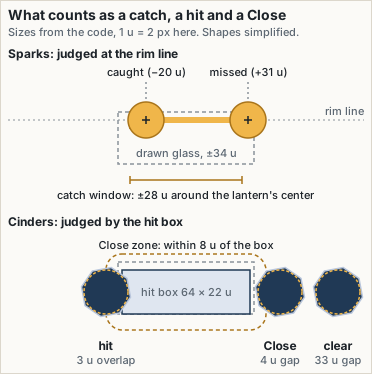
- Catch: a spark scores 1 point when its center crosses the lantern’s rim line within 28 u of the lantern’s center. There are no bonuses.
- Drop: a spark that crosses outside that window costs a light.
- Hit: a cinder that touches the lantern’s hit box costs a light. Hits are checked 120 times a second along the lantern’s whole path, so a fast slide cannot skip through one.
- Lights: you have three. They never come back, and the third one lost ends the run. There is no timer.
- Streak: catches in a row since your last lost light. The lantern glows brighter at 10, 25 and 50. It adds no points.
- Close: a cinder that passes within 8 u of the hit box without touching it.
Tips for longer runs
- Aim at the middle of the glass. It reaches 34 u from the center, but only 28 u counts, so a spark on its edge can still drop.
- Cross under a cinder while it is still high. It can only hurt while it passes the lantern’s height. From 18 s in, a cinder can fall beside the next spark, on the side facing your last one. Hold still until it passes.
- Move the moment you catch the first spark of an edge-to-edge pair. They appear from 25 s. The built-in margin is 0.35 s until 60 s, 0.20 s until 100 s and 0.04 s after.
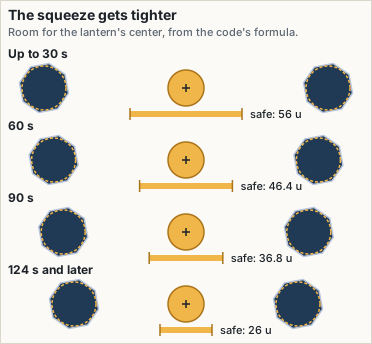
- Do not chase a squeeze. That is a spark between two cinders, from 35 s. Slide under the spark early and hold still. The safe stretch for the lantern’s center shrinks from 56 u to 26 u by 124 s.
Our numbers
These come from our game code and test scripts, not from visitors’ data. Method: How we test.
How a run speeds up
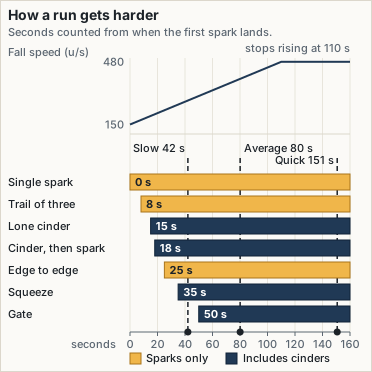
There is no difficulty setting; the table is worked out from the game code. Times count from when the first spark lands, 2.6 s after you start. The Time on your result card counts from the start, so it is 2.6 s longer, cut to whole seconds.
| Seconds in | Fall speed (u/s) | Time to fall to the lantern | Wait between patterns (×0.8 to 1.3) |
|---|---|---|---|
| 0 | 150 | 2.40 s | 1.15 s |
| 60 | 330 | 1.09 s | 0.64 s |
| 100 | 450 | 0.80 s | 0.30 s |
| 110 and later | 480 | 0.75 s | 0.26 s |
New patterns arrive at 8 s (trails of three sparks), 15 s (lone cinders), 18 s (cinder, then spark), 25 s (edge-to-edge pairs), 35 s (squeezes) and 50 s (gates: a row of cinders with one gap for a spark).
Fairness tests
On 29 October 2026 a simulated fair player played 10,000 Free play and 400 Daily courses of 300 s each, from 0 s. It reacts 0.26 s after an object appears, moves at up to 1,100 u/s, stays within 18 u of each spark’s center and keeps 10 u clear of each cinder.
- Lost lights: 0 in the full replays, and no pattern broke those rules.
- Shaky replays: each course 20 more times, with a 0 to 60 ms delay and up to 8 u of wobble. That is 208,000 replays, with 0 lost lights.
- Finger speed: for 99% of spark-to-spark moves in the Free courses, the average speed needed was at most 94 u/s (first 10 s), 166 (10 to 20 s), 309 (20 to 60 s) and 538 (after 60 s). Our limits are 120, 240, 450 and 800.
- Stable courses: building a course in small slices while you play matched building it at once for 1,000 of 1,000 seeds.
Three test bots
Each bot drives the game’s own movement and collision code, and ran 1,500 times (300 courses, five runs each) on 29 October 2026. All aim with some error. Slow and Average sometimes lift the finger or mistake a cinder for a spark (Slow three times as often); Slow’s finger also trembles.
| Bot | Reacts in, top finger speed | Median run | Middle 80% of runs | First 10 sparks caught |
|---|---|---|---|---|
| Slow | 0.50 s, 420 u/s | 42.1 s | 26.7 to 59.9 s | 97.4% |
| Average | 0.40 s, 650 u/s | 80.1 s | 60.5 to 93.5 s | 99.9% |
| Quick | 0.28 s, 900 u/s | 150.7 s | 100.6 to 225.6 s | 100% |
What we have not measured
- Speed gates: the finger-to-lantern delay (target: 95% of moves within 20 ms) and steady frame times need an idle test machine. Ours was busy on 19 and 29 October 2026, so both ended “not judged”, not passed. Two 95th-percentile readings on 29 October (CPU slowed 4×, 390 px wide) were 18.0 and 23.5 ms. We count neither.
- Real phones and people: every run above is a bot or an emulation. Our bulk tests also stop at 300 s.
Daily and records
- Fixed by the date: where and when each spark and cinder falls. Players whose device clocks show the same date share one course.
- Three tries, each from the start of that course. A try counts once its first spark appears (0.2 s in), so a reload mid-try uses it up. Between tries the card shows “Try 2 of 3” and “Today’s best”.
- Recorded once, at the end of try 3: the best of the three counts. Nothing is recorded before then, and unused tries keep until midnight. Reload during the third and your best so far counts, without the unfinished try. The next tap starts Free play.
- Records: Played and Best (in sparks), kept apart for Free play and Daily. The Daily adds Streak and Longest.
The Daily page lists the date and streak rules every game shares.
Frequently asked questions
Can every spark be caught?
In our tests, yes, for a fast and steady player: the simulated fair player lost no light in 10,400 courses of 300 s (29 October 2026). The bots do lose lights, and we have no results from people.
Can a cinder hurt me without touching the lantern?
No. The hit shapes sit inside the drawn ones: in our pixel check on 29 October 2026, no pixel inside a hit shape was empty. A cinder can overlap the glass’s edge on screen and still miss.
What happens if I lift my finger or switch tabs?
The lantern stays put while sparks keep falling. Switching tabs, or a stall of 250 ms or more, pauses the run. Resume with a tap, a click or a key (Space, Enter, P, Esc), then a 0.6 s ring fills.
Why can’t I restart straight away?
Taps are ignored for at least 1.2 s once the last light goes out, so a finger still down cannot skip your result. After that, a new tap of under 12 px, a click, or a fresh Space or Enter starts the next round.
Last updated: November 2, 2026.