How to play Nonogram
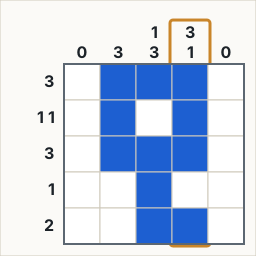
A nonogram is a grid with number clues beside each row and above each column. Each number is the length of one run of filled squares in that line.
Reading the clues
- A clue of 3 1 means a run of three filled squares, at least one empty square, then a run of one, in that order. A clue of 0 means no filled squares.
- The puzzle ends when your filled squares match the picture. Crosses are your own “this is empty” notes and do not count. The title appears only when you finish.
Controls on this screen
- Fill and cross. Pick Fill or Cross, then click or tap a square. A right-click or a 0.4-second touch press crosses. Clicking a filled or crossed square empties it.
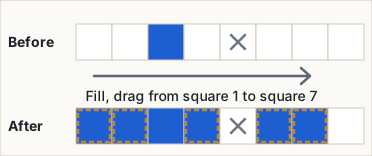
- Drag a line. After 8 pixels a drag locks to a row or a column and changes only squares in the same state as the first one. Nothing changes until you let go, and one Undo reverses the whole drag.
- Keyboard. Arrow keys move once the board has focus. Space or Enter fills, X crosses, Backspace clears. Esc twice within two seconds starts over.
- Undo, Redo and the ⋯ menu. Both have no limit (Ctrl + Z and Ctrl + Y, or ⌘ on a Mac). The menu holds Check, Start over, Picture shelf and Settings. Start over keeps the clock running, and Undo brings the board back.
- Big boards on a phone. 15×15 and 20×20 keep 28-pixel squares and scroll inside their frame, with the clues fixed. Move with two fingers. Whole board shows the full picture.
Tips and strategy
Every picture here can be solved one line at a time. These are the moves our checking solver makes.
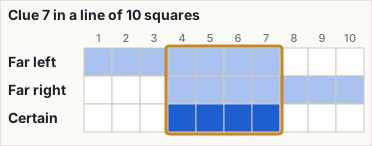
- Start where the slack is small. Slack is a line’s length minus its clues and the gaps between them. A run longer than its slack must cover the middle of its stretch: a 7 in 10 squares has slack 3, so squares 4 to 7 are filled wherever it slides. With slack 0 the whole line is decided.
- Cross what must be empty, then switch lines. When a line’s runs are placed, cross the rest. With the clue 3 and square 1 filled, squares 1 to 3 are filled and square 4 is crossed. Each settled square also helps its other line, so alternate between rows and columns. Settings can cross finished lines for you, or stop finished clues turning pale.
- Read the stars. On 10×10 and larger boards, ★★★ means a hard moment: under 5% of squares come from a first look, or at some step only one row or column can move. Re-scan every line there. ★ means a first look decides at least 20% and at least three lines can move at every step.
- Check at calm moments. One wrong square spoils later deductions. Check, in the ⋯ menu, marks wrong squares for 2 seconds and counts them. It does not show what is missing.
Our numbers
Counted from the 249 pictures in the game’s puzzle bank (last changed in October 2026, unchanged in the 29 October 2026 checks), unless a date says otherwise. The method is on How we test.
| Board | Pictures | ★ / ★★ / ★★★ | Squares decided by a first look (average) | Solver steps (average) |
|---|---|---|---|---|
| 5×5 | 31 | 31 / 0 / 0 | 58% | 9.5 |
| 10×10 | 140 | 86 / 43 / 11 | 48% | 26.4 |
| 15×15 | 51 | 25 / 20 / 6 | 40% | 46.3 |
| 20×20 | 27 | 16 / 9 / 2 | 42% | 65.9 |
A first look is one read of each row and column on the empty board. A solver step is one row or column settling a new square.
- Logic alone. On 29 October 2026 a separate solver re-solved all 249 pictures with line-by-line logic only: 249 of 249. It also re-solved the daily board for each of 431 days, from day −30 to day 400 (launch day is day 1), drawn from the 119-day schedule, with no failures.
- Why we check. Of all 33,554,432 possible 5×5 pictures, 24,976,511 (74.44%) are solvable by line logic alone (counted in full on 29 October 2026).
- Fixes. We drew all 249 pictures for this site. As drawn, 207 were already solvable by line logic. The other 42 needed 1 to 6 squares changed (at most 1 at 5×5, 3 at 10×10, 6 at 15×15, 4 at 20×20).
- Naming test. In October 2026 an AI model, not a person, tried to name 305 pictures shown as plain grids. A picture passed if at least 2 of 3 tries matched: 31 of 40 at 5×5, 140 of 180 at 10×10, 51 of 55 at 15×15, 27 of 30 at 20×20. We removed the 56 that failed, and every daily picture comes from the rest.
Daily puzzle and records
- One picture a day, always 10×10. It is the same for everyone with the same calendar date on their device, and a new one starts at midnight, your time.
- Weekdays are gentler. Monday to Friday pictures are ★ or ★★, weekend pictures ★★ or ★★★. The 119-day (17-week) schedule starts on Sunday 1 November 2026, then repeats. Counted from the schedule in the game’s code: of 85 weekday pictures, 75 are ★ and 10 are ★★. Of 34 weekend pictures, 23 are ★★ and 11 are ★★★.
- One recorded try a day. Your first solve of the day counts toward your streak and best daily time. Open Daily again to see that result and a Replay as practice button. Practice changes no records.
- Free play keeps a best time for each board size. Within a size it picks a ★ picture three times as often as a ★★★ one, skips pictures you have solved and holds back each daily picture until its day has passed.
- Saving. Your marks, time and check count save on this device: one unfinished board for the daily and one for each free-play size. The Undo history is not saved.
The streak and practice rules that every game shares are on the Daily page; the 10×10 schedule above is Nonogram’s own.
Frequently asked questions
Do I have to guess in a nonogram?
Not in this game. All 249 pictures were re-solved with line-by-line logic alone on 29 October 2026. If you are stuck, you have missed a deduction or an earlier square is wrong, so try Check.
Can a nonogram have more than one solution?
In general, yes. On a 2×2 board, rows 1 and 1 with columns 1 and 1 fit two different diagonals. Not here: line logic can finish a puzzle only when it has one answer, and it finishes all 249 pictures.
What are the crosses for?
A cross says “this square is empty”. It does not count toward the answer, but it cuts long lines into short pieces. A cross on a square that should be filled counts as wrong when you press Check.
What happens after I solve every picture of a size?
You get Pattern boards: left-right mirror patterns that line logic can solve. They show “Pattern” instead of a title and do not go on your Picture shelf. At 10×10, pictures still waiting for their daily date are held back, so Pattern boards can appear before you have seen all 140.
Where does the name nonogram come from?
Non Ishida, a Japanese graphics editor, won a competition in Tokyo in 1987 and published picture grid puzzles in Japan in 1988. The UK puzzle collector James Dalgety named them nonograms, joining “Non” from her name with “gram” from “diagram” (Wikipedia, checked 2026-11-01).
Last updated: November 2, 2026.