On this page
How to play Sliding Puzzle
The board holds numbered tiles and one empty gap. Slide tiles into the gap until the numbers run in order, row by row, with the gap in the bottom-right corner. The sizes are 3×3 (8 tiles, the 8 puzzle), 4×4 (15 tiles, the 15 puzzle) and 5×5 (24 tiles) (Wikipedia, checked 2026-11-02). You cannot lose.
Moves and controls
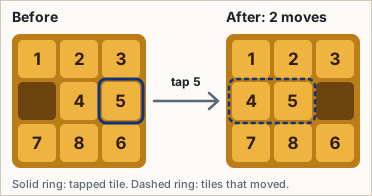
- Tap a tile in the gap’s row or column. It slides toward the gap, and so does every tile between the two. The move happens on the press, not the release.
- Moves count single tiles. One tile sliding one square is 1 move, so tapping 5 in the figure costs 2. A tile outside the gap’s row and column just wobbles, with no move counted.
- Swipe. Drag 20 pixels or more from the gap or from a tile that cannot move. The tile beside the gap slides the way you dragged.
- Keyboard. Click the board or Tab to it. Arrow keys slide a tile that way into the gap. Shift + arrow slides the whole line to the board’s edge. H is Hint, P is Picture and N starts a new Free play board. Settings (···) can make the arrows move the gap instead.
- Picture. It turns the tiles into pieces of an abstract picture the game draws itself, with no photos. Small numbers stay on the pieces unless you turn them off in Settings.
The target
On 3×3 and 4×4 the line under the board reads “Optimal: N moves”, the fewest moves that board allows. Your result adds how many moves you went over. 5×5 shows no target.
Tips and strategy
On 4×4 and 5×5 the game’s section lights and its Hint follow this routine. On 3×3 the Hint comes from the solver (step 5).
- Look before your first move. The clock starts on your first move and pauses while the tab is hidden.
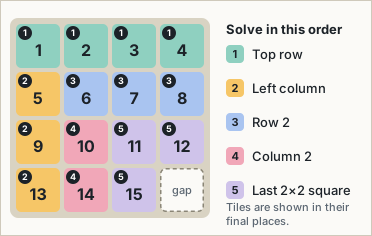
- Work from the top. Finish the top row, then the left column, then the next row, then the next column, until a 2×2 square is left. The game lights each stage (“Top row in place.”).
- Place the last two tiles of a row together. Put the second-to-last tile (3 in the top row) in the row’s final square and the last tile (4) directly under it. With the gap just left of the 3, slide the 3 left, then the 4 up. Turn it sideways for a column.
- Finish the last 2×2 by circling the gap. Keep your moves inside that block. The Hint (“Finish the last square”) rings the first move of the shortest way round inside it.
- Use the Hint for direction. On 3×3 it rings the first tile of a shortest solution. On 4×4 and 5×5 it rings the next tile in the order and outlines its square.
Our numbers
These come from the game’s code and its fairness tests, run on 29 October 2026 unless a line says otherwise. How we test explains how the solvers and checks are set up.
| Size | Where the board comes from | Best solution |
|---|---|---|
| 3×3 | A random solvable board, dealt again unless its best solution takes 20 moves or more | 20 to 31 |
| 4×4 | A bank of 1,000 boards solved in advance: 400 for the Daily, 600 for Free play (also flipped along the diagonal, so 1,200) | 46 to 56 |
| 5×5 | A random solvable board, dealt again if more than 3 tiles start in place | Not shown |
- 3×3, checked on every arrangement. The parity rule (first answer below) marks 181,440 of the 362,880 arrangements as solvable, exactly the boards a breadth-first search reaches from the finished board. Our solver’s answer matched that search on all 181,440, and every solution replayed from scratch to the finished board.
- 4×4 and 5×5 solvability. A second, separately written formula agreed with the rule on 200,000 random arrangements at each size. A random walk of 10,000,000 legal moves on 5×5 stayed solvable by the rule at all 10,000 checks, one every 1,000 moves. 5×5 has no solver behind it, so the game claims no best solution for it.
- The shuffle. In 10,000 shuffles per size, every board was solvable and none was already solved.
- 4×4 bank. All 1,000 boards pass the rule, none is already solved and none repeats, flipped copies included. Each Daily board’s saved shortest solution replays to the finished board in exactly its stored number of moves. A second, separately written solver matched the stored best on 200 of the shorter boards.
Daily puzzle and records
The Daily is always a 4×4 board from a list of 400. Everyone whose device shows the same date gets the same board. A new one starts at your local midnight, and #1 was 1 November 2026. The list starts again at #401 (6 December 2027) unless more boards are added. The Daily page covers what every game shares.
- One recorded try a day. Your first finish of the date counts toward Played, Best (fewest moves) and your streak. Open the Daily again to see it and a Replay as practice button, which changes no records.
- Watch the optimal solve. After a Daily or a Free play 3×3, the result can replay a shortest solution at 130 ms per move. Free play 4×4 and 5×5 boards keep no saved solution.
- Free play and saving. Each size keeps its own Played and Best, and an unfinished round records nothing. One unfinished Daily and one Free play board are saved on this device. Another size button or New drops the unfinished Free board for a new one, and only New asks first, after your first move.
Frequently asked questions
Can a sliding puzzle be unsolvable, and how can I tell?
Yes. Half of all starting arrangements cannot be solved (Wikipedia, checked 2026-11-02). Read the tiles row by row, skip the gap, and count the pairs where a bigger number comes first. On 3×3 and 5×5 the board is solvable only if that count is even. On 4×4, add the gap’s row number (0 for the top row), and the total must be odd. This is the parity rule the game uses.
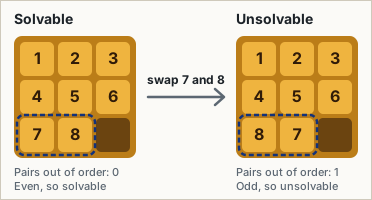
When a shuffle here fails the rule, the game swaps the two highest-numbered tiles (7 and 8 on 3×3), which makes it solvable.
What is the most moves a sliding puzzle can need?
Counting single tiles, as this game does, 31 on 3×3 and 80 on 4×4 (Wikipedia, checked 2026-11-02). In our tests (29 October 2026), our solver finds exactly 31 for the 3×3 board 8 6 7 / 2 5 4 / 3 _ 1, with _ as the gap.
Is there an undo or restart button?
No. There is no Undo, restart or auto-solve. Sliding a tile back works but is another move.
Do hints affect my record?
Each press is counted and shown on your result. “Optimal solve”, “Within 1.5× optimal” and “Fastest 4×4 yet” are awarded only without hints. Your Best is recorded either way.
Last updated: November 2, 2026.