On this page
How to play Reaction Time Test
Wait for the light, then press as fast as you can. Your result is the average of five counted lights.
The steps
- Tap the pad, click it, or press Space or Enter. Then let go. Letting go starts the wait.
- Wait while the pad reads “Wait for the light”. The wait is random, from 1.5 to 8 seconds.
- When a filled circle and “Tap!” appear, press. Your time in milliseconds shows at once.
- Press and let go again for the next light. The fifth counted light ends the set.
What counts
| Your press | What happens |
|---|---|
| Before the light | Early. Not counted. Redone after a new wait. |
| Under 110 ms after the light | Early. The page says it is faster than a person can react. |
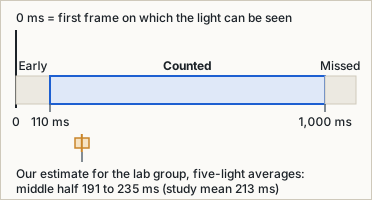
| 110 to 1,000 ms after the light | Counted. A press at exactly 1,000 ms still counts. |
| Over 1,000 ms | Missed. Not counted, redone. |
| The page is hidden or the window loses focus | Not counted, redone. |
| Your device skips frames as the light comes on | Not counted, redone. |
Three early presses make the set Unranked.
Controls on this screen
- Mouse: the main button, anywhere on the pad.
- Touch: a press counts when your finger lands. During the wait and the light, the pad stops page scrolling.
- Keyboard: click the pad or Tab to it first. A held key does not repeat.
- One input per set: the first counted light fixes it. A press from another input is not timed.
- Stray presses: a press is ignored if it began within 300 ms of a result (900 ms after a set). So is a press that slides 12 pixels or more before you let go.
- Reset: in Free play, Reset or Esc clears an unfinished set.
How the time is measured
- The clock starts on the first screen frame after the light is switched on, the first frame where you could see it.
- It stops at your press’s own browser timestamp, not when the page got round to handling it. If your browser’s timestamps are unusable, the press is timed when the page handles it, and the result says so.
- Your screen’s lag, your input device’s delay and your browser’s timer rounding stay in the number. We subtract none of them.
Tips and strategy
- Rest, don’t hover. Keep your finger on the key or button without pressing it. A touch or click during the wait is an early press.
- Don’t guess the light. The third early press makes the set Unranked. A fixed-time guess rarely gave a fast ranked set in our tests (see Our numbers).
- Compare like with like. Best and the trend are kept for each input, so stay on one input and device.
- Judge a set, not a light. One slow light lifts the average. The result also shows median, fastest, slowest and spread. Once three ranked sets are saved, it compares your average with the mean of your last ones, up to ten.
- Aim to be steady. “Steady” appears when your last 3, 4 or 5 lights each sit within 15 ms of their own average. “Tight set” means all five fall within 25 ms.
Our numbers
These numbers come from our own tests and one published study, not from visitors: this site collects no visitor scores. The method is on How we test.
The waits (October 2026, 1,000,000 generated waits)
- The shortest was 1,500.001 ms, the longest 7,999.904 ms and the mean 2,671.882 ms.
- The chance that the light comes next, given that it has not come yet, stayed within 9.451% of constant from 1.5 to 5.75 seconds (our limit is 20%). Up to about 5.75 seconds, waiting longer tells you almost nothing about when the light will come. Only the rare waits close to 8 seconds get more predictable.
- In our test suite, 3,650 of 3,650 Daily dates from 1 November 2026 gave the same first 20 waits in Node and in the browser.
Guessing and simulated players (October 2026, 10,000 sets each)
- A bot pressed at a fixed time after each wait began. We tried 20 timings from 1.6 to 3.5 seconds. It finished a set without being Unranked in up to 28.0% of sets.
- A set that also showed a percentile and averaged at or below the simulated human median (317.7 ms) came up in at most 0.64% of sets. Our limit is 1%, and all 20 timings passed.
- Simulated players had a reaction near 230 ms plus a slow tail, 50 ms of device delay and 2% early presses per light. In 10,000 of their sets, 2 (0.02%) were Unranked and 4.58% showed a percentile.
- These are simulations. They do not show that every clever script is caught.
The lab study. Woods et al. (2015) tested 1,469 adults aged 18 to 65, with 120 trials each. Their average was 231 ms as measured and 213 ms with hardware delay removed (17.8 ms: display 11.0, mouse 6.8). They counted presses from 110 to 1,000 ms, the window we use (checked 2026-11-01).
From their published spreads (27 ms between people, 40 ms from light to light) we estimate 32.2 ms for a five-light average. We treat it as a normal curve, so the middle half of lab five-light averages falls at 191 to 235 ms. It is an estimate, not a comparison with this site’s visitors. The table was computed on 2 November 2026 from the formula in the game’s code.
| Your five-light average | The result says |
|---|---|
| 170 ms | Faster than at least 90% |
| 190 ms | Faster than at least 76% |
| 230 ms | Faster than at least 29% |
| 254 ms | Faster than at least 10% |
| 280 ms | Faster than at least 1% |
| 288 ms or slower | No percentile |
Daily puzzle and records
The Daily is one set of five lights. Everyone whose device shows the same calendar date gets the same waits in the same order. A new one starts at midnight on your device’s clock and is numbered from #1 on 1 November 2026. The Daily page covers what the games have in common.
- One recorded set a day: your first finished Daily set counts. Replay as practice uses the same waits and changes no records.
- Leaving mid-set: counted lights are kept. A wait that was running counts as not counted, and its wait is used up.
- Streak and Best: a finished Daily set adds a day to your streak. An Unranked set counts as played and keeps the streak but sets no Best. Best is your lowest five-light average, kept apart for mouse, touch and keys, and for Daily and Free play.
- Free play: each set gets its own waits.
- Trend: your last 20 ranked sets per input, Daily and Free play together, feed a trend chart in the desktop side column.
- Sharing: the text line gives your average, five bars and your input (an Unranked set with early presses shows “N early” instead of the input). A bar is one light: ▁ is under 190 ms, each step up adds 40 ms, and █ is 430 ms or more. The share picture does not show the waits.
Records stay in your browser on this device. There are no accounts and no leaderboard.
Frequently asked questions
Why was my press counted as early?
It came before the light, or under 110 ms after it. 110 ms is the lower edge of the response window Woods et al. (2015) used. An early press stays out of your average, and the light is redone after a new wait.
What does “Faster than at least 29%” mean?
Your average includes your own device’s delay. The lab figure (213 ms) has theirs removed. So your reaction alone is at least as fast as your number says, and your true place is at least the percentage shown. The group is the 1,469 adults in Woods et al. (2015), not people who use this site.
Why does my result show no percentile, or say Unranked?
No percentile appears when your rounded average is 288 ms or slower, because the formula then gives under 1%. In our simulation of players with 50 ms of device delay, 4.58% of sets showed a percentile. Unranked means three or more early presses, or a browser timer that rounds to more than 20 ms. You still see your numbers, but no score is passed on, so Best does not change.
Why don’t you subtract my device’s delay?
We cannot measure it, and your hardware differs from the lab’s. The lab study corrected for its own display and mouse, 17.8 ms in total. Anwyl-Irvine and colleagues tested one web platform (jsPsych 6.0.5) with a robot finger. They measured a reaction-time delay of around 70 ms on desktops running Chrome or Safari, and around 110 ms on a Mac desktop running Firefox (accepted manuscript, checked 2026-11-02). That is other software on other machines. We subtract nothing and say “at least”.
Is this a medical test?
No. It times a press after a light on your device and browser. It is not a medical or health measure, and the lab comparison is only a reference point.
Last updated: November 2, 2026.