On this page
How to play Word Search
A word search hides a list of words in a letter grid, and the round ends when you mark the last one. Some people call it a word find or a word seek (Wikipedia, checked 2026-11-01).
Controls
- Drag: press the first letter and drag to the last. The line snaps to the nearest of 8 directions, so your finger can wander. The letters under it turn bold. To cancel, slide back to the first letter and let go.
- Tap twice: tap the first letter and a ring appears, then tap the last letter. The ring clears after 4 seconds, or when you tap the same letter again.
- Keyboard: press Tab to reach the board. Arrow keys move a cursor that starts in the middle. Enter or Space marks the start, then the end. Esc cancels.
- Hint: the ? button flashes the first letter of one unfound word twice (with reduced motion, it highlights the letter instead) and dots the word in the list. Hints are unlimited, and each one is counted.
- Level and new puzzle: in Free play, the Easy, Medium and Hard buttons deal a new puzzle at that level, and + deals another. From the Daily, + opens Free play.
- Settings: the sliders icon holds Print and the clock, which you can hide.
The rules
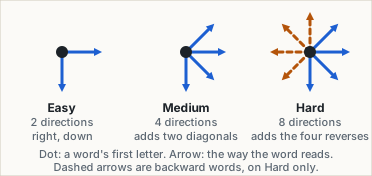
- Straight lines only. Each word runs along one row, column or diagonal. Words can cross and share letters. The level decides which directions are used.
- What counts as a find. Mark a word’s two end letters, in either order. A close line also counts. It must lie along the same line direction (either way), be within one letter of the word’s length, and have both ends within one cell of the word’s ends. If two unfound words fit, or a found word fits almost as well, the game picks nothing.
- Misses and streaks. A miss has no penalty and no mistake counter. Find words within 6 seconds of each other and a ×2, ×3 chip counts them. It changes neither your time nor Best.
- The end. After the last word, the found words glow in the order you found them. Then the letters that belong to no word fade back.
| Easy | Medium | Hard | |
|---|---|---|---|
| Board | 10×10 | 13×13 | 15×15 |
| Directions | 2 | 4 | 8 |
| Words | 10 | 16 | 20 |
| Word length | 4–8 letters | 4–10 | 3–11 |
| List order | where each word starts | A–Z | A–Z |
The counter above the board shows each board’s real word total.
Tips and strategy
- Hunt the odd letters first. Q, J, X and Z stand out, and Wikipedia lists them as a common strategy (Wikipedia, checked 2026-11-01). On Easy and Medium, our filler follows English letter frequency, so these four are under 0.5% of filler letters, fewer than 1 in 200. One you spot is a strong lead. On Hard, half the filler is drawn evenly from A–Z and half from the board’s own words, so a lone Z can be a dead end.
- Read the list as a map on Easy. Easy lists words in board order: words that start nearer the top come first (left to right within a row). Work down the list as you work down the board. Medium and Hard lists are A–Z and say nothing about position.
- Expect near-misses. A decoy is a word minus its last letter, spelled out somewhere else. Easy boards have at most 1, Medium 2 or 3, and Hard 4 to 6. If a line stops one letter short, you may have found a decoy. Keep looking instead of bending the line.
- Take long words first. Bigger words are easier to spot (Wikipedia, checked 2026-11-01). Three-letter words appear only on Hard, which is built with at least 3 words of four letters or fewer. Leave those for last.
- Use a hint late. It points at the first unfound word in list order. Save it for the last word or two.
- On a phone, tap twice for Hard. Its 15×15 grid has the smallest cells, and two taps let you place each end on its own.
Our numbers
Everything below was measured on our own boards, not on player data. The How we test page describes how these board checks are run.
How the levels differ
In our test suite we built 2,000 Free-play boards per level. The backward share for Hard comes from 10,000 Hard boards.
| Measure | Easy | Medium | Hard |
|---|---|---|---|
| Board cells per word | 10.0 | 10.6 | 11.3 |
| Cells shared by two words (average) | 4.6 | 10.1 | 13.6 |
| Decoys per board (average) | 0.24 | 2.09 | 4.07 |
| Words that run backward | none | none | 45.0% (built for at least 40%) |
Clean boards
Random filler can spell words you don’t want on a puzzle. In our test suite we kept each board’s words in place, filled every other cell with plain random letters and ran no check. A blocked word showed on 30.2% of Easy, 48.8% of Medium and 61.8% of Hard boards (2,000 boards per level). Our generator scans every row, column and diagonal in both directions for blocked words and their endings, such as plurals, -ED and -ING. It redraws filler until the board is clean.
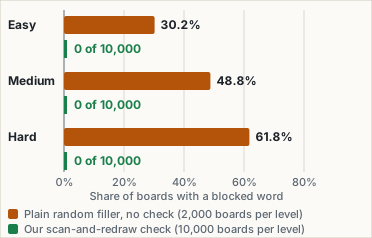
- QA run, 25 October 2026: 3,653 Daily boards and 10,000 Free-play boards per level. We found 0 blocked words and 0 failed boards.
- Second checker, same date: a separate program re-read 800 Daily boards and 30,000 Free-play boards from the plain grid. Each listed word reads exactly once, and no blocked word shows. It found 0 problems.
Picking a word with a drag
On 25 October 2026 we ran 92,000 test drags. Each aimed at one word on 600 boards (200 per level), with both ends placed at random inside the first and last letter’s cell. The right word was picked in 92,000 of 92,000 drags. When we stopped each of those drags one letter short of the last letter, the word was still picked 90.43% of the time in our test suite.
That same day we tried every straight segment on 180 sample boards (60 per level), 1,197,360 in total. None picked a word whose ends were more than one cell from the segment’s ends.
The word bank
- Size: 75 themes with 2,103 words, about 28 per theme. A board usually picks 10, 16 or 20 of its theme’s words (one fewer in rare cases). 48 of the words are two-word entries.
- Source: we wrote every list by hand for this site and copied none, choosing everyday words. We have no word-frequency table with a clear license, so no machine check of how familiar the words are has been run.
Daily puzzle and records
The Daily is always Medium: a 13×13 board with 16 words (15 in rare cases). Its theme comes from a fixed, shuffled order of the 75 themes, one per day, so a theme returns after 75 days. Anyone whose clock shows the same date gets the same board. It changes at your local midnight.
- What counts: your first finished Daily of the date. A finish counts toward Played and your streak, and sets Best if it is your fastest, whatever your hint count. Skip a date and the streak restarts at 1.
- Practice: open the Daily again later that day and you see your result with a Replay as practice button. It deals the same board and leaves your records alone.
- Result screen: time, hints used, your Daily average, your no-hint solves and your Dailies solved in the last 90 days. Those Dailies (time, hints and theme) are kept on this device.
- Free play: each level keeps its own Played, Best time, average and no-hint count. A round with hints still counts for Best. An unfinished board records nothing. It skips the last 20 themes you finished.
- Saving: one unfinished Daily and one unfinished Free-play board are saved automatically. A new Free-play puzzle or a level change replaces the saved Free-play board.
- Sharing: Copy result gives a short text with theme, level, words found, time and hints. The share picture uses only the order you found the words in and your hint count, so it shows no letters or word positions.
Your Word Search records and saved boards stay in this browser; the Daily page covers the rules shared by every game.
Frequently asked questions
Can words run backward or diagonally in Word Search?
Diagonals start at Medium (down-right and up-right). Backward words appear only on Hard, which uses all 8 directions. Easy words run right or down.
Can two words share a letter?
Yes. Words cross, and a crossing letter belongs to both. The generator does not choose a word that contains another list word, such as PEA inside PEAR.
Why do some list entries have two words?
Entries such as BUS STOP are two-word terms. The list shows the space, but the grid has none, so you look for BUSSTOP.
What happens if I select the wrong letters?
The band shrinks and fades, and nothing is counted against you. Only listed words count, so a word that appears in the filler by chance is not recognized. We check that each listed word appears once and that no blocked word appears, not that the filler spells nothing else.
Does the clock stop when I switch tabs?
Yes. The clock starts when the board appears and runs only while the page is visible. There is no time limit.
Can I print a Word Search puzzle?
Yes. Press Print in Settings, or use your browser’s print command. It prints the puzzle you are playing. Page 1 has the grid and word list. Page 2 has the answers, drawn as outlines in six line styles so crossing words can be told apart in black and white. On Hard, a note says some words go backward. In our 25 October 2026 test, the sheet came out as exactly 2 pages on both Letter and A4.
Who invented the word search?
Wikipedia says Norman E. Gibat designed and published the puzzle in the Selenby Digest on March 1, 1968, in Norman, Oklahoma. It adds that the Spanish puzzle maker Pedro Ocón de Oro was publishing “Sopas de letras” before that date (Wikipedia, checked 2026-11-01).
Last updated: November 1, 2026.