On this page
How to play Putt Streak
Each hole is a small walled room seen from above. A round starts with 5 balls. Each putt uses one, and your score is the number of holes you sink.
Controls
- Mouse or touch: press on the room, drag away from where you want the ball to go, and let go. A band, an arrow and a dotted path preview the putt. Full power is a pull of 36% of the room’s width, kept between 100 and 160 px.
- Cancel: let go within 10 px of where you pressed, right-click, press Esc, or touch with a second finger. No ball is used.
- Keyboard: Tab to the room. ← → turn the aim 1° (Shift: 0.25°; held down, 3° steps). ↑ ↓ change power 2% (Shift: 0.5%). Space or Enter putts.
What the ball does
- Flat floor, no spin, nothing moves. Full power rolls about 720 units (u) and stops in about 2 seconds (worked out from the game’s friction). The room is 360 u wide and 450 u tall.
- Bounces: a wall, block or post sends back 72% of the speed into it and keeps the speed along it.
- The cup takes a ball whose center is inside it and that moves slower than the hole’s speed limit. A faster ball rolls over.
Balls and scoring
| What happens | Balls | Score |
|---|---|---|
| Each putt | −1 | none |
| Sink on your first putt in a hole (an ace) | +2 back | +1 hole |
| Sink on a later putt | none back | +1 hole |
| Miss within 6 u of the cup’s rim (a close call) | none | shown in your result |
You hold at most 7 balls. The round ends when you have no balls and the last ball has stopped. If your last ball is an ace, the 2 balls it returns keep you going.
Tips for longer streaks
- Use the dotted line as a ruler. Holes 1 and 2 show the whole path, so line it up with the cup. From hole 25 you judge by the pull, and half power rolls about 360 u.
- Arrive slowly. A ball at hole 1’s speed limit (380 u/s) has about 200 u of roll left (speed² ÷ 720, from the game’s friction), and one at hole 45’s 220 u/s has about 67 u.
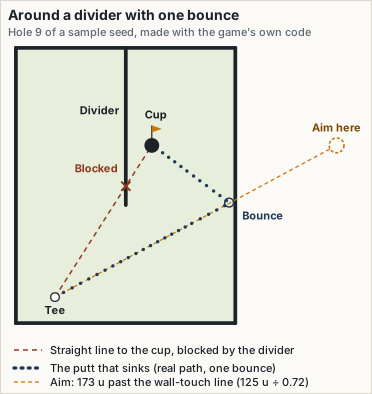
- Mirror the cup for a bank shot. When a divider hides the cup, find the line where your ball’s center sits when it touches the wall. Aim 1.4 times as far past that line as the cup is short of it (1 ÷ 0.72), because the wall returns only 72% of the push.
- Use the helpers while they last. A hand shows how far to pull back on your first 3 putts, and a faint one-bounce line shows in your first 3 holes when the cup is not in direct view.
Our numbers
Figures come from the game’s code and our test runs, dated where our notes give a date. How we test explains our checks.
How the holes get harder
| Holes | Cup radius (u) | Speed limit (u/s) | Dotted path shown |
|---|---|---|---|
| 1–2 | 15 | 380 | whole path |
| 3–4 | 14 | 370 | 60% |
| 5–7 | 13 | 350 | 35% |
| 8–11 | 12 | 330 | 35% |
| 12–16 | 11.5 | 310 | 30% |
| 17–24 | 11 | 300 | 20% |
| 25 and up | 10 down to 7.5 | 280 down to 220 | none |
From hole 25 the cup shrinks 0.15 u per hole to 7.5 u (hole 42), and the speed limit drops 3 u/s per hole to 220 (hole 45). Blocks and posts appear from hole 3, gates from 5, doglegs (a divider between tee and cup) and diagonal walls from 8, alcoves from 12, zigzags from 17.
What the generator checks
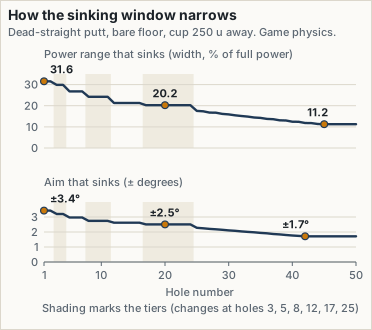
Each hole gets up to 16 layout tries. The generator wants one where a modeled careful hand, shooting a straight or one-bounce line 40 times (aim off by about 1°, power by about 4%), sinks at least 50% to hole 16, 40% to hole 24 and 30% after, and from hole 12 no more than 95%, 85% or 75%. Failing that, it takes a too-easy layout, then a plain open room with one straight 200 u putt. That room uses the hole’s own cup and speed limit and must pass the same checks before it is served.
Before we added a 196-shot re-check, a 200-shot check found 43 of 400,000 Free-play and 2 of 24,000 Daily holes more than 10 points under their minimum. The runs below came after it.
Test results
| Check | Result | Date |
|---|---|---|
| Free-play holes, 10,000 seeds × 40 holes | All 400,000 passed the 40-shot check and an independent 200-shot check that allows 10 points under the minimum (lowest 0.2 against a 0.3 minimum; that hole’s 40-shot rate was 0.325). 7 holes used the plain open room (limit 1%). From hole 25, 3.82% were too easy (limit 8%). 838,089,326 floor points had 0 stuck spots, and 0 of 800,000,000 test shots stopped outside the floor. | 2 November 2026 |
| Daily holes, 400 dates × 60 holes | All 24,000 passed. 0 plain open rooms, 328 too-easy holes. 0 were more than 10 points under (was 2). | 2 November 2026 |
| Scripted players, 300 rounds each | Median holes sunk: Loose 6 (middle 80%: 4–9), Steady 9 (5–15), Precise 25 (14–37). Precise reached the 50-hole limit in 1 of 300 rounds. | 2 November 2026 |
| Dotted path against the real roll, in a browser | 10,000 of 10,000 random putts identical | 25 October 2026 |
| Daily holes in Chromium and Node, 400 dates × 30 holes | identical hash. 4 of 4 date-change boundaries matched. | 25 October 2026 |
The players are programs, with aim wobbles of about 2.5°, 1.6° and 0.6°. We give no round times, because ours are modeled.
Not measured or not passed
- Speed: not judged. On 22 October 2026, over 20 putts at 390 and 1,280 px, the 95th-percentile frame time was 16.7 ms, but a 53 ms startup long task is not shown fixed and the game has changed since.
- Other browsers and players: the hole hash was not checked in WebKit, Firefox was not run, and our notes record no real-phone test. We have no player data, so we give no finish rates.
Daily and records
- Fixed by the date: each hole’s layout, cup and speed limit come from the date on your device and the hole number. Your putts cannot change them.
- Three tries: each starts at hole 1 with 5 balls. A try counts when you let go of its first putt, and it is saved then, so a reload gives nothing back.
- Recorded: when the third try ends, your best try becomes your one counted Daily (more holes first, then fewer strokes, then more aces; an exact tie keeps the earlier try), with its aces, strokes and close calls. After one or two tries nothing is recorded yet; your tries wait in this browser until the date changes.
- Afterward: Putt Streak reopens in Free play, and the Daily tab brings back your result. In our 25 October 2026 check, a fourth try did not start.
The Daily page covers how Dailies work across our games.
Frequently asked questions
Why did my ball roll over the cup?
It moved faster than the hole’s speed limit: 380 u/s in holes 1–2 and 220 u/s from hole 45.
Can a hole be impossible?
We check each hole so a modeled careful hand can sink it, as described above. All 400,000 Free-play and 24,000 Daily holes we tested on 2 November 2026 passed, and we claim nothing beyond those seeds.
Are there slopes, spin or moving obstacles?
No. The ball bounces only off walls, posts and blocks (drawn as water pools).
Last updated: November 2, 2026.