On this page
How to play Spider Solitaire
Spider Solitaire uses two decks, 104 cards. You win by building eight runs, each one suit from king down to ace. A finished run leaves the table by itself.
The layout
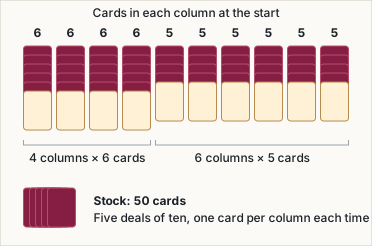
The table has ten columns. The first four start with six cards and the other six with five. Only the bottom card of each column is face up, so 44 cards start face down and 10 face up. The other 50 wait in the stock, as five deals of ten.
- 1 suit: every card is a spade, so any sequence that goes down one rank at a time is a run.
- 2 suits: spades and hearts, and only a same-suit sequence is a run.
The daily deal is always 2 suits. There is no 4-suit mode (why).
The rules
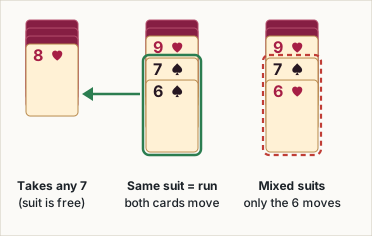
- Pick up a card or a run. Take the bottom card of a column, or a run that ends the column. In 2 suits, 7♠ 6♠ 5♠ is a run. 7♠ 6♥ is not.
- Land it one rank higher. Drop it on a card exactly one rank higher, in any suit, or into an empty column. Ace is low and king is high, so a king can only move into an empty column.
- Turn over what you uncover. A face-down card flips by itself once it is the bottom card.
- Deal from the stock. One card lands face up on each column. You can’t deal while any column is empty, unless fewer than 10 cards remain on the table.
- Clear finished runs. When a column ends in a king-to-ace run of one suit, its 13 cards leave and fill one of eight slots beside the clock. The eighth run wins.
Controls on this site
- Tap or click a card to move it and the cards below it in its run. The game picks a column ending in the same suit first (longest such run first), then any other legal column, then an empty one. It won’t move a whole column into an empty one, because that only swaps places.
- Tap the same card again within 2.5 seconds to try the next legal column.
- Drag a run to pick the column yourself. A drag starts after 8 pixels, and the cards ride 28 pixels above your finger.
- The Deal button at the bottom right shows deals left, 5 at the start.
- Undo, Redo, Hint, Restart and More sit below the board. On a screen narrower than 340 pixels, Redo moves into More.
For the keyboard, focus the board by clicking it or pressing Tab.
| Key | Action |
|---|---|
| ← → | Select the neighboring column (wraps around) |
| ↑ ↓ | Select a higher or lower card within the movable run |
| Enter | Move the selected cards, like a tap |
| Space | Pick up the selected cards; press it on another column to drop them |
| D | Deal from the stock |
| U / Y | Undo / Redo |
| H | Hint |
| Esc | Put down held cards, or restart the deal if you hold none |
- Undo has no limit. One press takes back one move, with any card it flipped, run it cleared or stock deal it made.
- Restart deal rewinds to the first position. Your clock, move count and undo count stay, and Redo brings your moves back.
- Counter and clock: the move counter includes undone moves, and undos are counted separately. The clock starts at your first move and pauses while the tab is hidden.
- Finish replaces Hint when the stock is empty, no card is face down and the game finds a win within 2 seconds. It plays the rest at 60 milliseconds a move, uncounted.
Spider Solitaire tips and strategy
- Flip cards first. 44 of the 54 cards start face down. Hint ranks its ideas this way: finish a run, turn a card over, empty a column, lengthen a same-suit run. Use that order as a checklist.
- Hold the stock back. A deal puts a card on every column and buries what you were working toward. Make each flip and same-suit join first.
- Plan around empty columns. An empty column takes any run and is the only home for a king, but it blocks dealing until it is filled. Empty one when you can refill it soon.
- Keep suits together in 2 suits. A heart on a spade is legal, but that stack comes apart only from the bottom. A tap tries a same-suit column first, so check where the card went before you tap again.
- Press Hint twice. The second press on the same position shows the next idea. Hint sees only face-up cards, so treat it as a suggestion.
- Test plans with Undo. Only a hint can cost you a Best time. For a harder game, aim for a “Clean win”: no undos, no hints.
- Expect tall columns. Winning lines in our bank build columns up to 31 cards. On a tall column the board first folds the middle of same-suit runs above your movable cards.
Our numbers
Every number below comes from the game’s data files and test records. We give the date wherever a record carries one. The solver tests are undated in the game’s README. How we test explains the method.
The deal bank
We read the game’s deal index on 1 November 2026. Each deal has a winning line: a stored list of the moves our solver used to win it.
| Bank | Deals | Winning line, median (range) |
|---|---|---|
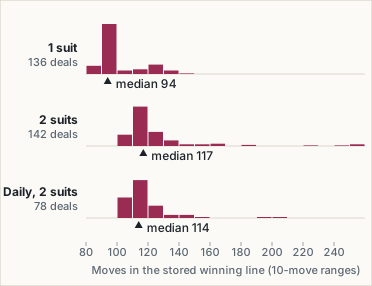
| 1 suit, free play | 136 | 94 moves (87–140) |
| 2 suits, free play | 142 | 117 moves (101–256) |
| 2 suits, daily | 78 | 114 moves (102–204) |
| 4 suits | 0 | none |
In a winning line, a stock deal is one move. At the median, 2 suits take 23 more moves than 1 suit. A winning line is one solution, not the shortest. The result screen shows its length as “Our solver” and adds “Fewer moves than our solver” if the moves left in your winning line, after undos, are fewer. That count is not your move counter, which keeps undone moves and leaves out Finish’s moves.
On 25 October 2026 we replayed all 356 stored lines on freshly dealt boards, using the game’s own rules code. All 356 ended with eight runs cleared. The same check found no repeated deal and no daily deal that also appears in free play. The tallest column in those lines held 31 cards.
Solver tests
In the solver tests recorded in the game’s README, we measured our solver, which sees every card, on deals numbered from 1. Each deal had a time and search limit.
| Test | Deals tried | Limit per deal | Solved | Median time per win |
|---|---|---|---|---|
| 1 suit, standard search | 200 | 5 s, 500,000 positions | 37 (18.5%) | 1.2 s |
| 2 suits, standard search | 200 | 20 s, 2 million positions | 5 (2.5%) | 5.0 s |
| 2 suits, beam search | 40 | 120 s, 2 million positions | 36 (90%) | 2.9 s |
| 4 suits, standard search | 40 | 60 s, 5 million positions | 0 | none |
Read these as speed tests of our own search, not as the share of deals that can be won: a deal the solver misses within its limit may still be winnable. We keep only deals it won. We added the beam search because, at that rate, the standard search’s projected time to build the 2-suit bank was over 3 hours.
The board on a phone
In our layout check of 22 October 2026, ten columns fit across a 390-pixel phone with 34×48-pixel cards and 15-pixel rank text. At 360 and 390 pixels wide, the game box ended 758 pixels from the top of the page.
Daily deal and records
- Same deal for everyone. Anyone who plays on the same calendar date gets the same 2-suit deal. A new one starts at midnight, your time.
- The bank. On 1 November 2026 the daily bank holds 78 deals. They are used in order, so the list starts over after 78 days.
- One counted game a day. Your first finished daily counts, whether you win or choose End game. After that, “Replay as practice” plays the same deal again and leaves your stats alone.
- What is recorded. Played, Win %, Best time, Streak and Longest, on this device only. Best time counts only wins without hints. A lost or skipped day ends your streak. Free play keeps separate records for each suit count.
- Sharing. A win’s share text is a strip of symbols: a dot for each stock deal, a suit symbol for each finished run, then your undo count. It shows no cards.
What all daily games have in common is on the daily page.
Frequently asked questions
Can every Spider Solitaire deal be won?
Probably not every random deal. For four-suit Spider, the author of a solver called plspider reports 3 games still unsolved out of around 131,000 and calls 1 in 40,000 “a reasonable, round-numbers estimate” of how many such games exist (plspider results, checked 2026-11-01). Unsolved is not the same as proven unwinnable. Each deal here can be won, because our solver has already won it and we replayed its line (356 of 356 on 25 October 2026). You can still lose, because the solver sees face-down cards and you don’t.
For players, Wikipedia quotes a handbook figure of “about 1 in 3 games” for a normal game with good play (Wikipedia, Spider (solitaire), citing Hoyle’s Rules of Games, checked 2026-11-01). Your records stay on your device, so we have no win rate of our own.
What is the difference between 1 suit and 2 suits?
With 1 suit every card is a spade, so any descending sequence moves as one run. With 2 suits only same-suit sequences move together, so a heart on a spade makes a stack that can’t move as a unit. In our bank, 2-suit winning lines run longer: a median of 117 moves against 94 (read 1 November 2026).
Is there a 4-suit mode?
No. The game offers 4 suits only once its bank holds at least 30 deals our solver has won. In our solver tests it won 0 of 40 four-suit deals within 60 seconds each, so that bank is empty as of 1 November 2026. The Four-color suits option in More recolors clubs and diamonds, so it changes nothing in 1-suit or 2-suit games.
Do Undo and Hint affect my Best time and streak?
Undo doesn’t. A hint does: Best time is saved only for a win with no hints. A win with hints still counts as a win and extends your daily streak. “Clean win” means no undos and no hints. A hint counts once per board position, so pressing it twice on the same position costs one.
What does “No way forward” mean?
It appears when the stock is empty and the game’s search, which uses only the cards you can see, finds no move sequence that turns a card over, empties a column or finishes a run. The search covers up to 20,000 positions or 1.5 seconds and shows nothing if it hits either limit. You can Undo, Restart deal, or choose End game, which records a loss.
What happens if I start a new deal mid-game?
Before your first move, nothing is lost. After that, free play asks first: the old deal then counts as a loss, and you have 6 seconds to undo that. In the daily, New deal takes you straight to free play and keeps your daily game for later that day.
Sources and checks
- Our numbers: computed from the game’s own deal index on 2026-11-01, and from the game’s test records: solver tests (undated in the README), 2026-10-22 (board sizes) and 2026-10-25 (replay check). Rules and controls were read from the game’s code on 2026-11-01.
- Solver results: plspider results, opened 2026-11-01: “Out of around 131,000+ games, 3 are currently unsolved. So 1 in 40,000 looks like a reasonable, round-numbers estimate of how many unsolved games of two deck, four suit Spider Solitaire there are.”
- Win chances: Wikipedia, Spider (solitaire), opened 2026-11-01, citing Hoyle’s Rules of Games, 3rd edition (2001), p. 205.
Last updated: November 1, 2026.